






NEWS
Categories List
Recent Posts
 Netherlands Client Delegation Visits Our Factory to Advance European Highway Guardrail CooperationOct 10, 2026
 AASHTO M180 Guardrail Requirements: A Practical Guide to Material ComplianceOct 10, 2026
 Port Safety Barriers: Selecting Protection for Vehicle Lanes and Loading AreasOct 10, 2026
Comparing Z post guardrail price with W beam guardrail cost gets complicated as soon as the discussion moves past the rail panel itself. A Z post system may look economical in one drawing and expensive in another because the post shape, steel thickness, coating weight, foundation conditions, and terminal details all shift the final amount. W beam cost has the same problem: one line item can refer only to the corrugated rail, while another includes posts, spacer blocks, bolts, end treatments, and installation tolerances. Without a clear bill of materials, two quotations that seem close in wording may refer to very different assemblies.
The first cost driver is section design. A Z post is a support member, while a W beam is typically the longitudinal rail profile. That means the comparison is not always direct unless both are placed inside the same roadside barrier system. If a project drawing specifies W beam guardrail with Z posts, then the rail cost and post cost should be separated before any judgment is made. In some layouts, the post geometry reduces steel usage or simplifies driving into soil. In other layouts, the same shape may require heavier material, stronger splice regions, or closer spacing near bridges, embankments, transitions, and curves.
Material grade changes the quote faster than most expect
Steel grade is one of the easiest places for cost misunderstandings. Two guardrail components can have similar dimensions on paper but different yield strength, elongation behavior, and forming requirements. A higher-strength post may reduce deformation in impact, yet it can also increase raw material cost and place tighter demands on punching and bending. For W beam panels, forming consistency matters because wave depth, straightness, hole position, and splice fit all affect installation. If the drawing requires stricter dimensional control, scrap risk and inspection time can rise even before galvanizing is considered.
Thickness also needs careful reading. Nominal thickness, minimum delivered thickness, and post-galvanizing thickness are not interchangeable terms. A quotation based on nominal steel only may appear lower than one based on a more restrictive acceptance method. In practice, small thickness differences across rail, post, blockout, and connection plates can change transport weight, galvanizing consumption, and lifting requirements during installation.
Galvanizing is often the hidden separator
When roadside steel is exposed to rain, deicing salts, standing moisture, and debris accumulation, corrosion protection cannot be treated as a minor accessory. Hot-dip galvanizing usually adds a visible amount to cost, but skipping detail here creates a larger problem later. Buyers often compare one price based on a lighter coating assumption with another based on a heavier or more tightly controlled coating standard. The result is a false comparison.
Surface preparation also matters. If the fabrication route includes rust removal, shot peening, cleaning after drilling, and control of burrs before galvanizing, the coating adhesion and finish quality tend to be more stable. Additional painting systems, when specified, further alter the total. For coastal roads, mountain routes with high humidity, or industrial corridors with airborne contaminants, the coating requirement may need to be higher than on a dry inland section. That condition alone can move the balance between Z post guardrail price and W beam guardrail cost.
Spacing and foundation assumptions can overturn an early estimate
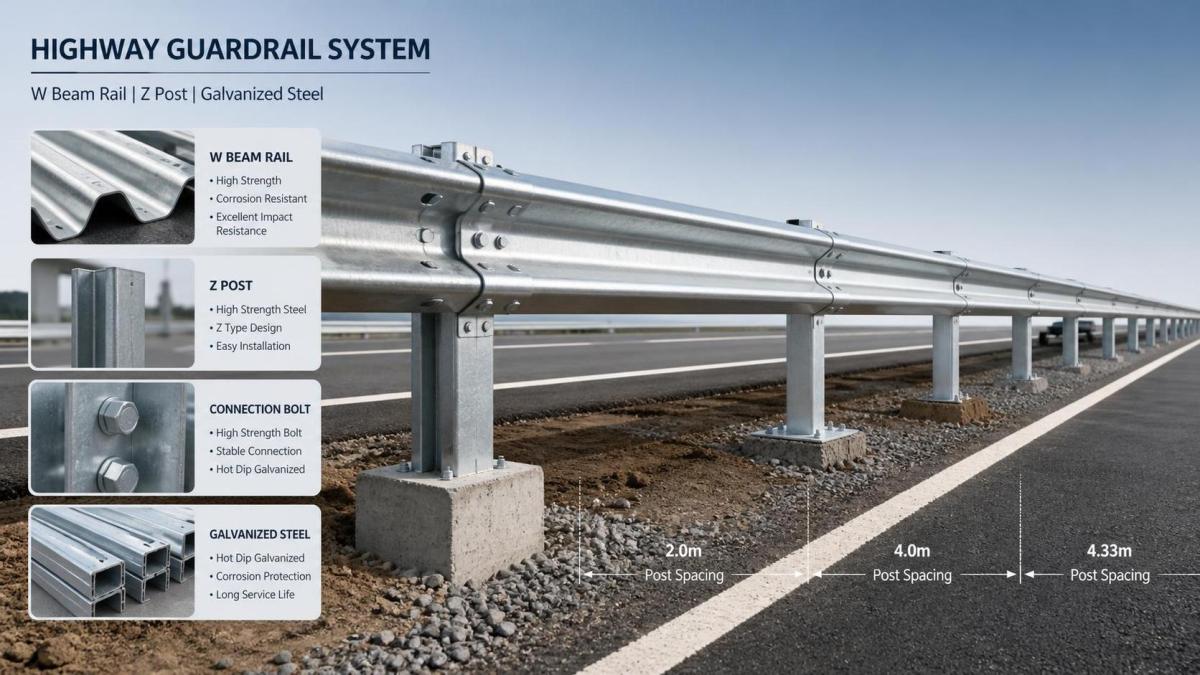
Many preliminary budgets assume uniform post spacing along the whole alignment. Real projects rarely stay that simple. Standard spacing might be 4 meters in a typical section, while critical locations may shift to 2 meters because of impact exposure, approach conditions, or structural transitions. Once spacing tightens, post count, bolt count, drilling time, handling, and installation duration all increase. A rail that seemed inexpensive per meter can become a higher-cost system per installed length when support density rises.
Foundation conditions are equally important. If posts can be driven directly into stable soil, installation may proceed quickly. Where rock, buried utilities, drainage structures, culverts, retaining edges, or pavement constraints appear, the support detail changes. Base-plated members, predrilled holes, anchors, or local concrete work may replace simple post driving. In such cases, the support assembly deserves more attention than the rail panel. In highway guardrail systems, components such as U Post Base Plate may be specified where vertical support, load transfer, and anti-overturning performance matter, especially when spacing changes at critical points or non-standard posts are required due to diameter, wall thickness, or length constraints.
Fabrication complexity is real cost, even when it is hard to see in a quote
A straight W beam segment with common hole patterns is simpler to manufacture than a batch containing mixed lengths, special punching, non-standard slot positions, or unusual transition geometry. The same applies to posts. If a Z post order includes multiple sizes, mixed embedment lengths, reinforcement details, post caps, and connector variations, workshop efficiency drops. Production still moves, but setup frequency rises and quality control becomes more demanding.
Drilling and punching are not interchangeable from a cost standpoint. Hole quality influences assembly fit, and repeated mismatch in the field creates secondary expense through rework and delayed lane possession. Bending accuracy matters too. If guardrail elements arrive with slight deviations that force adjustment across long runs, the labor effect may exceed the apparent saving from a cheaper unit price.
Non-destructive testing, dimensional inspection, and coating inspection can also shift the quote. These are not decorative extras. They become relevant when the project requires tighter verification of weld quality, base plate attachment, or coating continuity after fabrication.
Transport and site handling distort simple per-ton comparisons
Guardrail components do not travel as neatly as steel plate in a warehouse calculation. Long W beam sections occupy truck length efficiently, but mixed accessory loads can reduce packing density. Posts, especially when supplied in several profiles, may create awkward loading combinations. Remote routes, restricted unloading windows, and staged delivery to active road sections all add cost that is easy to miss in an early comparison.
Installation sequencing should be read together with transport. If posts arrive before the earthwork or shoulder preparation is complete, site handling increases. If the rail is delivered before alignment is marked, bundles may need to be moved twice. None of that changes the steel price, but it changes the installed cost, which is usually the figure that matters in the end.
Common mistakes in comparing Z post and W beam costs
- Using rail price per meter from one source and complete system price from another.
- Ignoring whether the quoted post spacing is standard or tightened at hazard points.
- Assuming all galvanizing references mean the same coating mass and inspection requirement.
- Leaving out fasteners, spacer blocks, terminal parts, transition sections, or post caps when reviewing totals.
- Treating non-standard fabrication as if it carries the same manufacturing efficiency as repetitive standard lengths.
Another frequent problem is drawing status. Preliminary design, issued-for-tender drawings, and construction drawings can produce different cost logic. A quotation prepared from an incomplete alignment may exclude many details that later become mandatory. Curved sections, bridge approaches, median openings, and drainage conflicts tend to appear more clearly only after design coordination advances.
Where the better value usually comes from
The better value does not come from choosing the lower visible unit rate. It usually comes from matching the support type, rail profile, coating system, and installation method to the actual road condition. If the line is long, uniform, and suitable for driven posts, a standard arrangement may control cost well. If the route contains repeated constraints, a cheaper nominal rail may lose its advantage once foundations, spacing changes, and custom attachments are included. In some projects, the support component governs the budget; in others, corrosion protection or traffic control during installation becomes the larger issue.
A useful comparison separates the system into rail panels, posts, blocks, connectors, protective coating, freight, and installation conditions. Once those parts are visible, the difference between Z post guardrail price and W beam guardrail cost becomes easier to judge on technical grounds rather than by headline numbers alone.
Leave A Reply
Need More Details?
Contact me for details on creating and managing design projects, project features, and services and prices
consult
Our company was established in 1998. It‘s a Chinese pioneer enterprise integrating production and sales, committed to providing high-quality steel products to customers at home and abroad.

First class quality service and professional after-sales team.
Get in Touch
*We respect your confidentiality and all information are protected.