






NEWS
Categories List
Recent Posts
 Netherlands Client Delegation Visits Our Factory to Advance European Highway Guardrail CooperationOct 10, 2026
 AASHTO M180 Guardrail Requirements: A Practical Guide to Material ComplianceOct 10, 2026
 Port Safety Barriers: Selecting Protection for Vehicle Lanes and Loading AreasOct 10, 2026
Ports are unforgiving places for vehicle control. Container tractors, forklifts, reach stackers, delivery trucks, maintenance vehicles, and visiting hauliers often share tight corridors with pedestrians, parked equipment, loading doors, utility cabinets, and quay-side infrastructure. A minor steering error in a warehouse may damage racking; the same error in a port can block a lane, rupture a service line, or put people in the path of heavy moving equipment. Selecting a suitable Port Safety Barrier is therefore less about placing steel along an edge and more about controlling how vehicles behave in a complex working environment.
For safety and quality teams, the most useful question is not “Which barrier is strongest?” It is “What must this barrier stop, redirect, separate, or protect—and under what operating conditions?” The answer changes between a gate approach, a container-handling lane, a loading dock, a fuel-service area, and a pedestrian crossing.
Start with the traffic pattern, not the catalogue
Barrier layouts often fail because the design begins with a standard product section instead of an actual vehicle movement review. A port lane may look straightforward on a site plan, yet the risk changes at shift handover, during poor visibility, when trailers queue, or when a driver reverses to correct an approach angle. These are the moments when a barrier is most likely to be tested.
Walk the area with operations personnel and observe more than the marked routes. Look for tyre marks near kerbs, damaged bollards, informal shortcut paths, blind turns around stacked cargo, and places where drivers stop to check documents. Those details reveal where a physical separation is needed and where better markings, lighting, signage, or traffic management may solve part of the problem without overbuilding the barrier line.
A practical assessment should identify the likely vehicle type, travel direction, approximate operating speed, approach angle, available stopping distance, and the consequence of penetration beyond the barrier. A low-speed forklift contact near a pedestrian walkway calls for a different solution than an articulated truck approaching a loading apron on a wet surface. Treating both with the same rail height and post spacing is a common, expensive mistake.
Match the barrier form to the risk at each location
There is rarely one universal Port Safety Barrier solution across an entire terminal. Continuous steel guardrail systems are useful where a vehicle needs to be guided away from an exposed edge, a building face, stored materials, or a pedestrian zone. Heavy-duty bollards may be more appropriate around access-control equipment, charging points, fire cabinets, and column bases. At loading areas, guardrails may need to work alongside wheel guides, dock edge protection, marked pedestrian routes, and reversing controls.
The ends of a barrier deserve particular attention. A run of rail can perform well along its length but still create a severe hazard if a vehicle meets an exposed terminal head-on. Where the geometry and operating risk justify it, a purpose-designed terminal can help absorb collision energy, reduce the chance of a rail penetrating the vehicle body, and guide the vehicle toward a more controlled stop along the rail line. A hot-dip galvanized Ped Terminal is one example of the type of end treatment that should be assessed when highway-style guardrail protection is adapted for port roads or perimeter approaches.
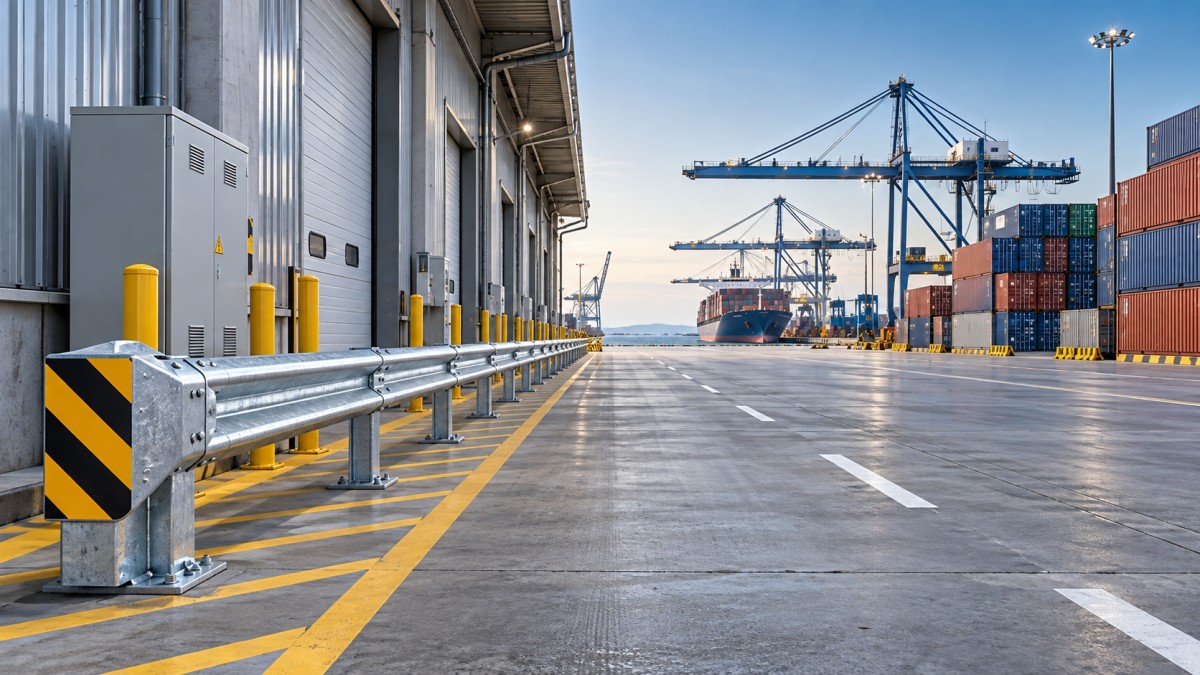
Do not assume that a terminal designed for one roadway setting can simply be installed anywhere on a port estate. Its suitability depends on the barrier system, foundation arrangement, impact direction, clearance, and the relevant project requirements. The terminal and rail should be considered as one system rather than as separately selected pieces of steel.
Corrosion protection is an operational decision
Salt-laden air, standing water, washdown activity, abrasive dust, and repeated contact all shorten the useful life of poorly specified protection. In coastal terminals, corrosion is not a cosmetic concern. Once coating damage develops around post bases, bolt holes, weld zones, and drainage points, inspection becomes harder and section loss may progress where it is least visible.
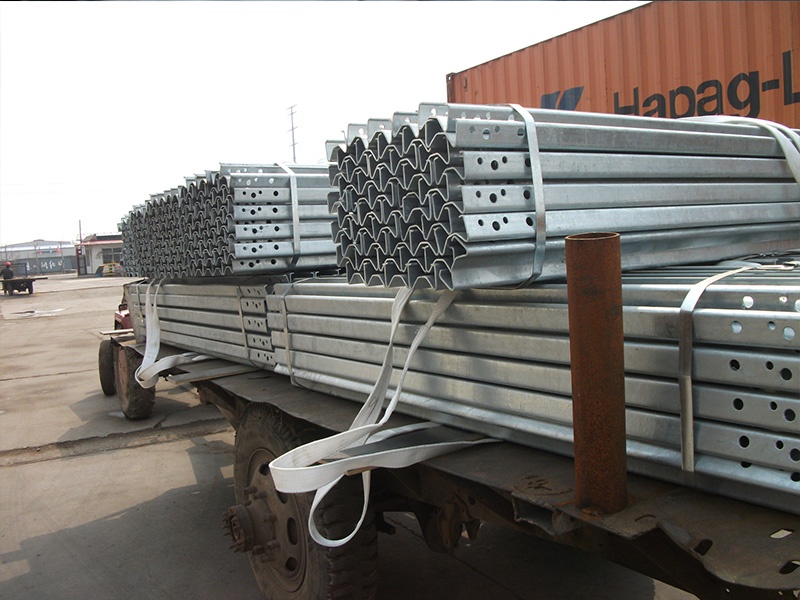
Hot-dip galvanizing is commonly chosen for steel barrier components because it provides broad coverage and durable corrosion resistance in demanding outdoor service. But the specification should go beyond simply writing “galvanized.” Quality managers should confirm surface preparation expectations, treatment of drilled or fabricated areas, coating condition after transport and installation, and the repair method for site damage. Where visual zoning, high-visibility requirements, or additional environmental protection are necessary, a compatible paint system may also be considered.
Drainage is often overlooked. A robust rail will not compensate for posts installed in locations where water accumulates, concrete cracks, or debris stays trapped around the base. Good detailing keeps water moving away from the support and preserves access for routine inspection.
Installation details determine whether the design works
A barrier can be correctly specified and still underperform if its anchorage is unsuitable. Before installation, verify what is below the surface: slab thickness, reinforcement, drainage channels, buried services, pavement condition, and whether the surrounding ground can transfer the anticipated loads. This is especially relevant near weighbridges, quay utilities, dock pits, and older paved areas that have been repaired several times.
The working space also matters. Rails placed too close to a loading door may limit door swing or trailer alignment. A barrier installed without enough offset from a pedestrian route can leave no safe refuge if it deflects during impact. Conversely, an excessive offset may invite drivers to use the gap for staging pallets or parking small equipment. A site drawing is necessary, but a physical set-out review before final fixing catches problems that drawings do not always show.
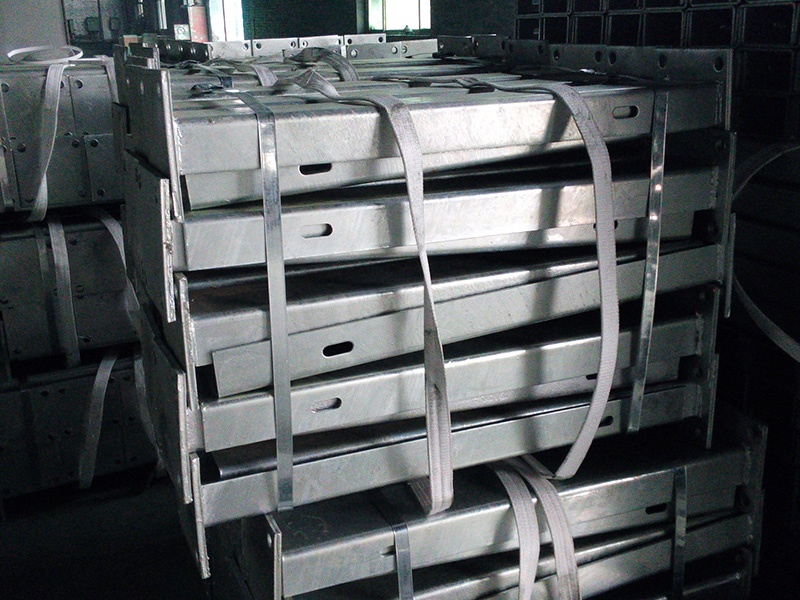
When barriers are manufactured to a project plan or drawings, fabrication control should cover the small details that influence fit-up: drilling positions, bends, rail lengths, post geometry, connection hardware, and coating sequence. Capable steel fabrication may include rust removal, shot peening where specified, non-destructive testing when the project requires it, galvanizing, and painting. These are not interchangeable steps; they should follow the approved material and inspection requirements for the job.
Use inspection as a management tool, not paperwork
Barrier damage is easy to normalize in busy yards. A scraped rail, bent post, loose bolt, or chipped coating can remain in service because vehicles continue to pass. Yet visible damage may indicate that the system has already absorbed an event outside its intended condition. It may also mean the traffic layout is encouraging repeated contact at the same point.
A useful inspection routine separates immediate hazards from maintenance observations. Check for distorted rails, displaced posts, cracked foundations, loose or missing fasteners, damaged terminal sections, sharp projections, compromised coatings, and clearance changes caused by nearby storage. Record the location and likely cause where possible. If the same barrier is struck repeatedly, replacing the rail without changing the lane geometry or operating rule merely resets the cycle.
Avoid buying protection by weight alone
Heavier steel is not automatically safer. Overly rigid protection in the wrong place can transfer loads into a slab, wall, or anchorage that was never designed for them. A lighter arrangement may be inadequate where a loaded truck can approach at an angle. The correct choice comes from balancing containment, redirection, deflection, foundation capacity, clearance, corrosion exposure, and maintainability.
Before approving a solution, ask the supplier to work from the actual layout, vehicle information, and operating constraints—not only a requested rail length. A provider able to support quotation, design coordination, manufacturing, and installation can reduce gaps between the drawing, fabricated components, and site conditions. For critical areas, retain drawings, material records, installation checks, and inspection criteria as part of the site safety file.
The best barrier arrangement is usually the one drivers barely notice because it makes the safe route obvious, leaves enough room for normal work, and protects people and assets when normal work goes wrong. In a port, that quiet reliability is the real measure of a sound decision.
Leave A Reply
Need More Details?
Contact me for details on creating and managing design projects, project features, and services and prices
consult
Our company was established in 1998. It‘s a Chinese pioneer enterprise integrating production and sales, committed to providing high-quality steel products to customers at home and abroad.

First class quality service and professional after-sales team.
Get in Touch
*We respect your confidentiality and all information are protected.