






NEWS
Categories List

What a Guardrail Really Means in Roadside Safety
A guardrail is not simply a steel barrier placed along the edge of a road. In transport engineering, it is a controlled safety device meant to manage what happens when a vehicle leaves its intended path. That distinction matters. A guardrail is not there to stop every vehicle instantly, and it is not designed to make impact disappear. Its job is to redirect, contain, or slow an errant vehicle in a more predictable way than a ditch, bridge pier, embankment, sign support, or drop-off would.
When people ask what a guardrail is, they are often really asking a broader question: why place a barrier at all? Roadside design usually starts with the idea that the safest obstacle is no obstacle. If a hazard can be removed, relocated, or the slope can be flattened, that may be preferred. A guardrail enters the picture when the roadside condition itself creates a higher risk than the barrier. In other words, the system is a compromise, but often a necessary and carefully engineered one.
That is why highway guardrails are specified by performance, geometry, and installation details rather than appearance alone. Two barriers may look similar from a distance and behave very differently in a crash if post spacing, rail height, end treatment, steel thickness, or anchorage changes.
The Main Types You Will See
In everyday discussion, “guardrail” often refers to the corrugated steel beam system seen on highways. In practice, roadside barriers can be grouped by form and by how they manage impact.
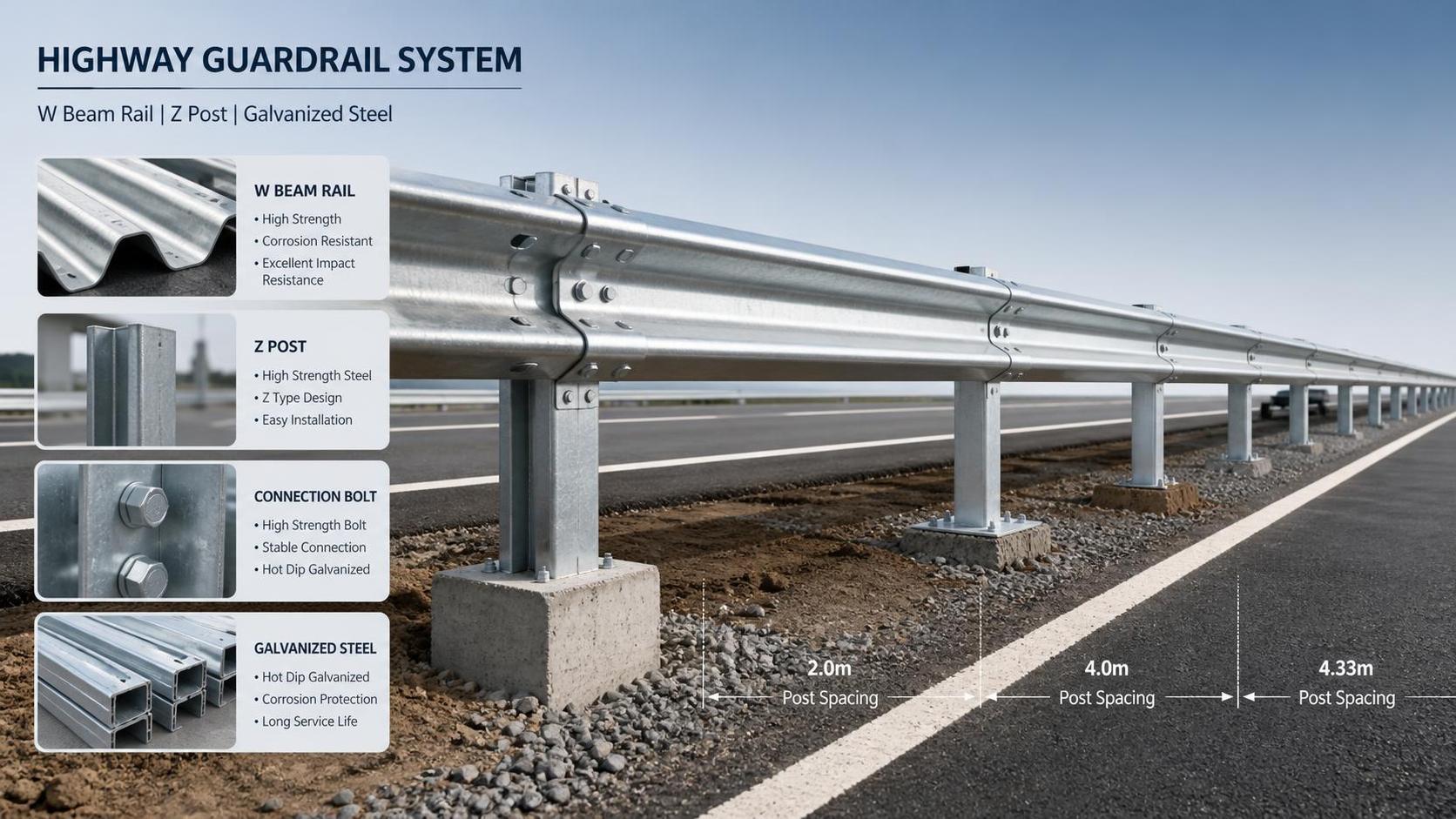
The most familiar type is the steel beam guardrail, commonly using W-beam or thrie-beam profiles. These systems rely on the rail, posts, blockouts, and connections working together so the barrier can deflect and guide the vehicle. They are widely used because they are adaptable, repairable, and suitable for many road classes when properly selected.
Cable barriers are another category. They are more flexible and can absorb energy through greater deflection, which makes them useful in some medians and recovery areas where there is room for movement. Concrete barriers, by contrast, are much more rigid and are often chosen where space is limited or deflection must be tightly controlled, such as on bridges, in narrow medians, or near fixed infrastructure.
There is also a practical difference between longitudinal barriers and terminals. The rail length along the roadside does the continuous redirection work, but the barrier end is its own safety problem. An untreated end can become a severe hazard. That is why end treatments and transitions are not minor accessories; they are part of the system.
What a Guardrail Is Expected to Do
The basic functions sound simple, but each has design consequences. A guardrail should reduce crash severity, keep the vehicle from reaching a more dangerous object or terrain condition, and redirect it along the barrier path rather than allowing sudden rollover, penetration, or vaulting. In some situations, it also separates traffic streams or protects maintenance zones, pedestrians, utilities, and structural elements.
One common misunderstanding is that a stronger rail is always better. It is not that straightforward. If a system is too rigid for the site condition, vehicle type, and installation context, impact forces can rise or vehicle behavior can become less forgiving. If it is too weak, it may deflect excessively or fail to contain the vehicle. Good barrier selection is about controlled performance, not maximum hardness.
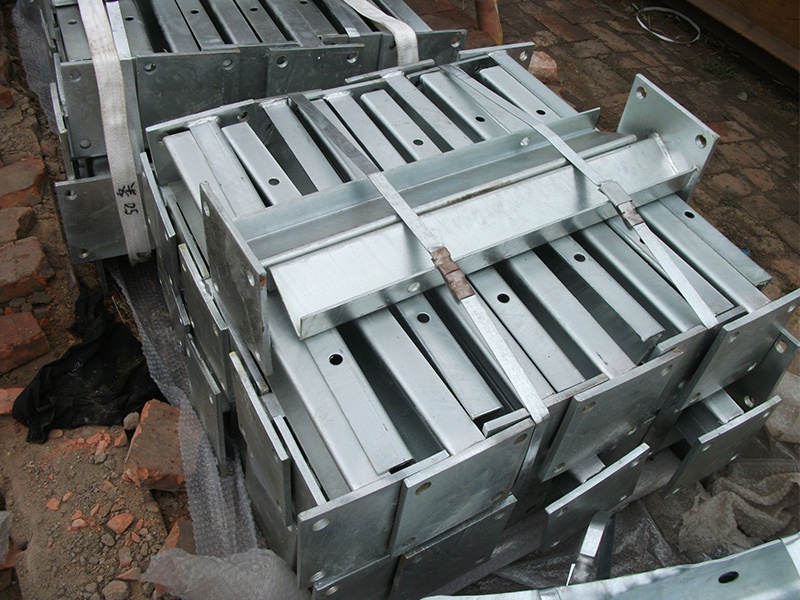
Another point that gets overlooked is that the rail itself is only one part of the assembly. Posts, splice bolts, blockouts, brackets, anchorage, and corrosion protection all matter. Even a small connection component can affect load transfer and alignment. In fabricated steel systems, support parts such as Angle Bracket pieces may be used in related roadside or structural mounting arrangements, depending on the project design. That does not make every bracket interchangeable; these details need to follow the engineered drawing and the approved barrier configuration.
Why Installation Quality Changes Performance
A guardrail system can meet specification on paper and still perform poorly if manufacturing or installation is careless. Rail height, post embedment, spacing, soil condition, transition alignment, and terminal placement all influence behavior during impact. This is one reason transport projects treat barrier work as a system task rather than a simple metal supply job.
From a manufacturing perspective, consistency matters more than visual neatness alone. Drilling accuracy affects bolt fit and splice performance. Bending quality affects geometry. Surface preparation, galvanizing, and coating influence long-term corrosion resistance, which is especially relevant in wet, coastal, or de-icing salt environments. For steel guardrail producers, processes such as rust removal, shot peening, non-destructive testing, galvanizing, and painting are not decorative add-ons. They support durability, dimensional reliability, and traceable quality when the product must match project drawings and installation requirements.
This is also where custom manufacturing becomes relevant. Not every road project uses an off-the-shelf arrangement. Bridge transitions, special post details, and connection hardware may need to be produced according to approved plans. A manufacturer that can quote, design around project needs, and fabricate to drawings is usually solving a practical engineering problem, not just shipping standard lengths of rail.
How to Think About Standards and Selection
People researching guardrails often look for one universal standard, but barrier selection is usually tied to local highway authority requirements, project specifications, and accepted crash-testing criteria. The important question is less “Which guardrail is best?” and more “Which tested and approved system is appropriate for this roadside condition?” Speed environment, traffic mix, available deflection space, proximity to fixed objects, maintenance access, and terrain all shape that answer.
If you are comparing systems, pay attention to what exactly is being compared: barrier profile, containment level, working width or deflection characteristics, terminal type, corrosion protection, and whether the supplied components match the tested configuration. A barrier that looks equivalent in a brochure may not be equivalent in service if critical details are altered.
That is especially true in procurement. Buyers sometimes focus on steel tonnage or unit price first, but roadside safety hardware should be judged as an installed system. Material quality, fabrication precision, and drawing compliance matter because field adjustments can introduce risk. The same applies to related components such as posts, spacers, and a second Angle Bracket detail when it forms part of a specified connection.
The Most Useful Way to Understand Guardrails
The clearest way to understand a guardrail is to stop seeing it as a roadside fence. It is a crash-management system with a narrow purpose: to make a bad event less severe than the alternative. Whether it succeeds depends on where it is placed, what hazard it is shielding, which barrier family is chosen, and whether every component is manufactured and installed as intended.
So when evaluating guardrails, ask practical questions. What hazard is being addressed? Is there enough space for barrier deflection? Is the end treatment suitable? Do the fabricated parts match the approved drawings? Are corrosion protection and installation details appropriate for the environment? Those questions will tell you far more than the word “guardrail” by itself.
Leave A Reply
Need More Details?
Contact me for details on creating and managing design projects, project features, and services and prices
consult
Our company was established in 1998. It‘s a Chinese pioneer enterprise integrating production and sales, committed to providing high-quality steel products to customers at home and abroad.

First class quality service and professional after-sales team.
Get in Touch
*We respect your confidentiality and all information are protected.