






NEWS
Categories List
Recent Posts
 Netherlands Client Delegation Visits Our Factory to Advance European Highway Guardrail CooperationOct 10, 2026
 AASHTO M180 Guardrail Requirements: A Practical Guide to Material ComplianceOct 10, 2026
 Port Safety Barriers: Selecting Protection for Vehicle Lanes and Loading AreasOct 10, 2026
Start with the right unit price question
When someone asks for the cost of a Guardrail system per meter, the first useful answer is usually another question: cost of what, exactly? In transportation projects, the meter rate only becomes meaningful when the scope is locked down. A low number can hide missing posts, thinner steel, a different coating, or difficult installation conditions. For business evaluators comparing bids, that is where mistakes start.
A practical review should separate the meter rate into product cost, accessory cost, surface treatment, logistics, installation, and compliance-related requirements. Once you do that, supplier comparisons become much cleaner, and budget risk drops fast.
What to check before you compare any per-meter quote
- Barrier type and profile. A W-beam system and a thrie-beam system are not interchangeable in price or performance. If a hazardous road section needs a stronger containment setup, the cost per meter will rise because the rail profile, steel usage, and sometimes post spacing will differ.
- Steel specification. Ask whether the quote is based on the same thickness, base steel grade, and component weight across all bidders. A cheaper meter rate often comes from reducing steel mass, not from better manufacturing efficiency.
- Coating method. Galvanizing, painting, or a combined system changes the price structure and the service-life expectation. In corrosive environments, coating is not a cosmetic item. It is a lifecycle cost decision.
- Included components. End terminals, spacer blocks, bolts, nuts, posts, reflectors, transitions, and anchor assemblies can add substantial cost. Some quotations only cover the rail panel itself.
- Installation basis. Soil condition, shoulder width, traffic control, drilling needs, and equipment access can move the installed meter rate more than the material price does.
If those five points are not aligned, the “cheapest” Guardrail quote usually stops being the cheapest once the purchase order is issued.
Read the quote like a cost sheet, not a sales sheet
For procurement work, the useful question is not just “What is the price per meter?” but “Which cost drivers are fixed, and which will move after design review?” Ask suppliers to break the quotation into visible blocks. That makes later variation claims easier to challenge.
A supplier that can quote, design, manufacture, and install against your drawings or project plan will usually be in a better position to keep these interfaces consistent. That matters because many cost overruns happen between fabrication and site execution, not inside the factory.
Check standards before discussing price concessions
This is where procurement teams sometimes lose time. They negotiate price first and discover later that bidders were pricing against different compliance assumptions. For transportation projects, you need the standard and drawing set identified early in the RFQ package.
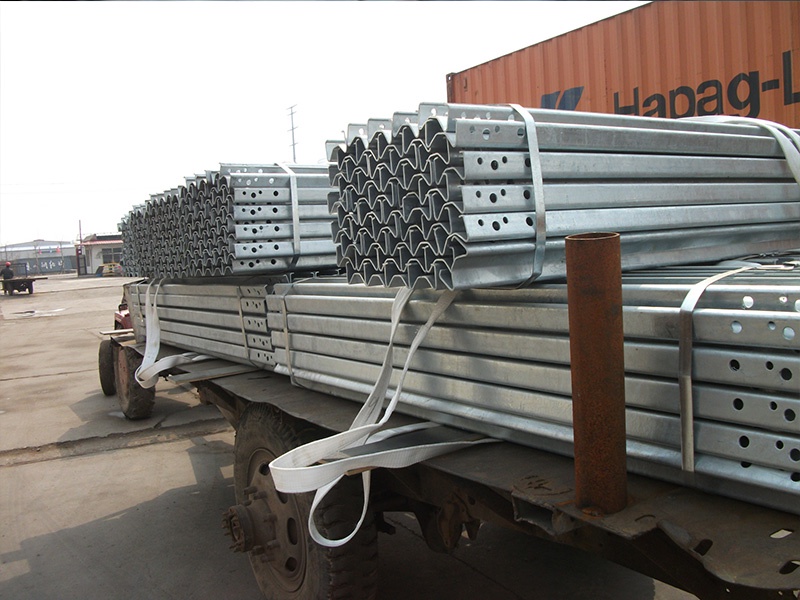
Look for the exact specification reference in the quotation, not a generic statement about quality. If the project requires compliance with named standards, the quote should state that basis clearly. For example, a system such as Thrie-Beam Guardrail may be relevant for highways and hazardous road sections where higher-performance roadside protection is part of the design intent, and its listed references include U.S. AASHTO M180 and Brazil’s ANBT standards. The point is not to force one product into every project. The point is to compare prices only after you confirm everyone is pricing the same compliance target.
Do not ignore manufacturing steps that affect long-term cost
Per-meter pricing is often treated as a raw steel question. In practice, process quality matters too. Drilling accuracy, bending quality, rust removal, shot peening, non-destructive testing, galvanizing, and painting all influence fit-up, coating integrity, and field performance. These are not abstract factory details. Poor execution here shows up later as installation delays, coating failures, or rejected batches.
A cheap quote becomes expensive very quickly when site crews start reworking hole alignment or replacing damaged coated parts. Ask what production stages are included, and whether fabrication follows your drawings without redesign assumptions hidden in the supplier scope.
Use service life to frame value, not just purchase price
Not every road environment deserves the same corrosion strategy, but every evaluator should ask the same question: what are we buying over the asset life? In coastal, humid, or de-icing salt exposure zones, a stronger coating system can justify a higher initial meter rate if replacement and maintenance access are expensive.
As one example, a hot-dip galvanized thrie-beam configuration marketed for corrosion resistance and impact performance may offer a service life of over 20 years under suitable conditions. That does not automatically make it the right choice for every package, but it does give procurement teams a better way to compare offers: not only by purchase price, but by expected intervention frequency and downtime exposure.
Common bid comparison mistakes
- Comparing supply-only pricing with supply-and-install pricing.
- Missing terminal sections and transition details in the quantity takeoff.
- Assuming galvanized and painted systems are equivalent because both “meet appearance requirements.”
- Using one meter rate across straight runs, bridge approaches, curves, and hazardous sections.
- Accepting a quote that references no drawings, no bill of materials, and no standard basis.
Most of these are avoidable if the RFQ includes drawings, performance basis, coating requirement, delivery terms, and installation assumptions in one package.
A workable review sequence for business evaluators
- Confirm the road section type and whether the project needs standard roadside protection or a heavier-duty barrier arrangement.
- Match all bidders to the same drawing set, bill of materials, and named standard references.
- Split each quote into material, accessories, coating, freight, and installation.
- Check whether manufacturing processes and inspection steps support the required finish and dimensional accuracy.
- Review lifecycle exposure: corrosion environment, maintenance access, and replacement disruption cost.
- Only then compare the final per-meter number.
If you follow that order, the meter rate becomes a useful decision tool instead of a misleading shortcut. In guardrail procurement, the best-priced offer is usually the one with the clearest scope, the cleanest compliance basis, and the fewest surprises between fabrication and installation.
Leave A Reply
Need More Details?
Contact me for details on creating and managing design projects, project features, and services and prices
consult
Our company was established in 1998. It‘s a Chinese pioneer enterprise integrating production and sales, committed to providing high-quality steel products to customers at home and abroad.

First class quality service and professional after-sales team.
Get in Touch
*We respect your confidentiality and all information are protected.