






NEWS
Categories List

Why Radius and Post Spacing Matter More Than Many Drawings Suggest
A Bend Highway Guardrail is not just a straight barrier forced into a curve. Once the alignment changes, the system stops behaving like a simple line of steel and starts acting like a shaped energy-management structure. That is where curved radius and post spacing become critical. They affect whether the rail can redirect a vehicle smoothly, whether posts can carry the load path without tearing the system apart, and whether the installed geometry still matches the intent of the design.
In technical reviews, one of the most common mistakes is to treat bend geometry as a secondary fabrication issue. It is not. A tight radius can change rail tension behavior, overlap fit-up, bolt alignment, and blockout position. At the same time, post spacing influences how the impact load spreads along the run. If either parameter is handled carelessly, the guardrail may still look correct after installation but perform poorly under collision loading.
Curved Radius Is About Load Path, Not Just Shape
Radius determines how abruptly the barrier changes direction. A larger radius generally allows the rail to behave more like a conventional semi-flexible system, with smoother vehicle redirection and more predictable rail deformation. A smaller radius introduces stronger geometric restraint. That can increase local stress at lap joints, bolts, and posts, especially near the entry into the curve or at the point of maximum deflection demand.
This matters because guardrails do not absorb energy through one component alone. The rail element deforms, posts rotate or yield in soil, blockouts help prevent wheel snag, and the system redirects the vehicle over a certain working width. When the curve becomes sharper, those mechanisms no longer distribute force in the same way they do on a straight run. In practice, technical assessors usually need to check whether the specified bend radius remains consistent with the approved guardrail family, connection detail, and installation standard rather than assuming field bending will be acceptable.
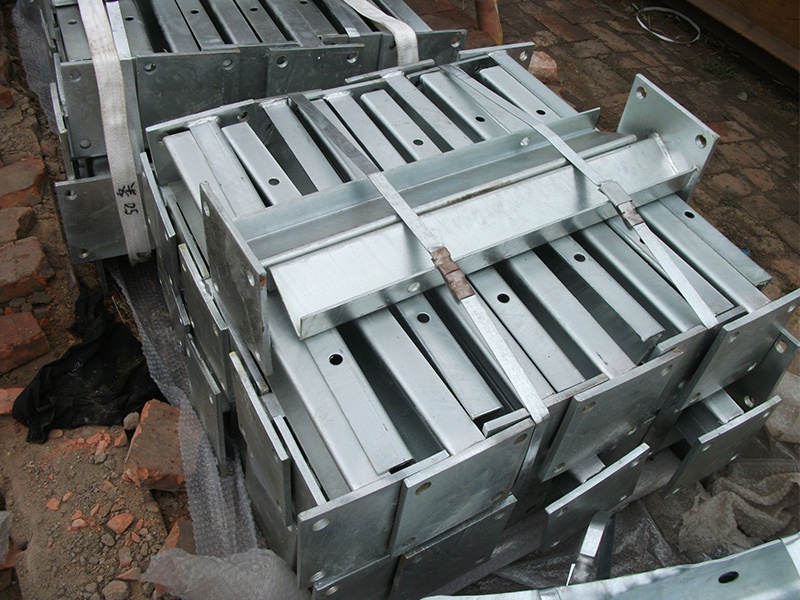
Another point that often gets missed: a radius that is manufacturable is not automatically a radius that is advisable. Steel can be bent to match drawings, but excessive forming can affect hole alignment, coating continuity after processing, and fit between adjacent sections. For projects requiring drilling, bending, rust removal, shot peening, non-destructive testing, galvanizing, and painting, process control matters because performance begins long before the barrier reaches the roadside.
Post Spacing Changes System Stiffness
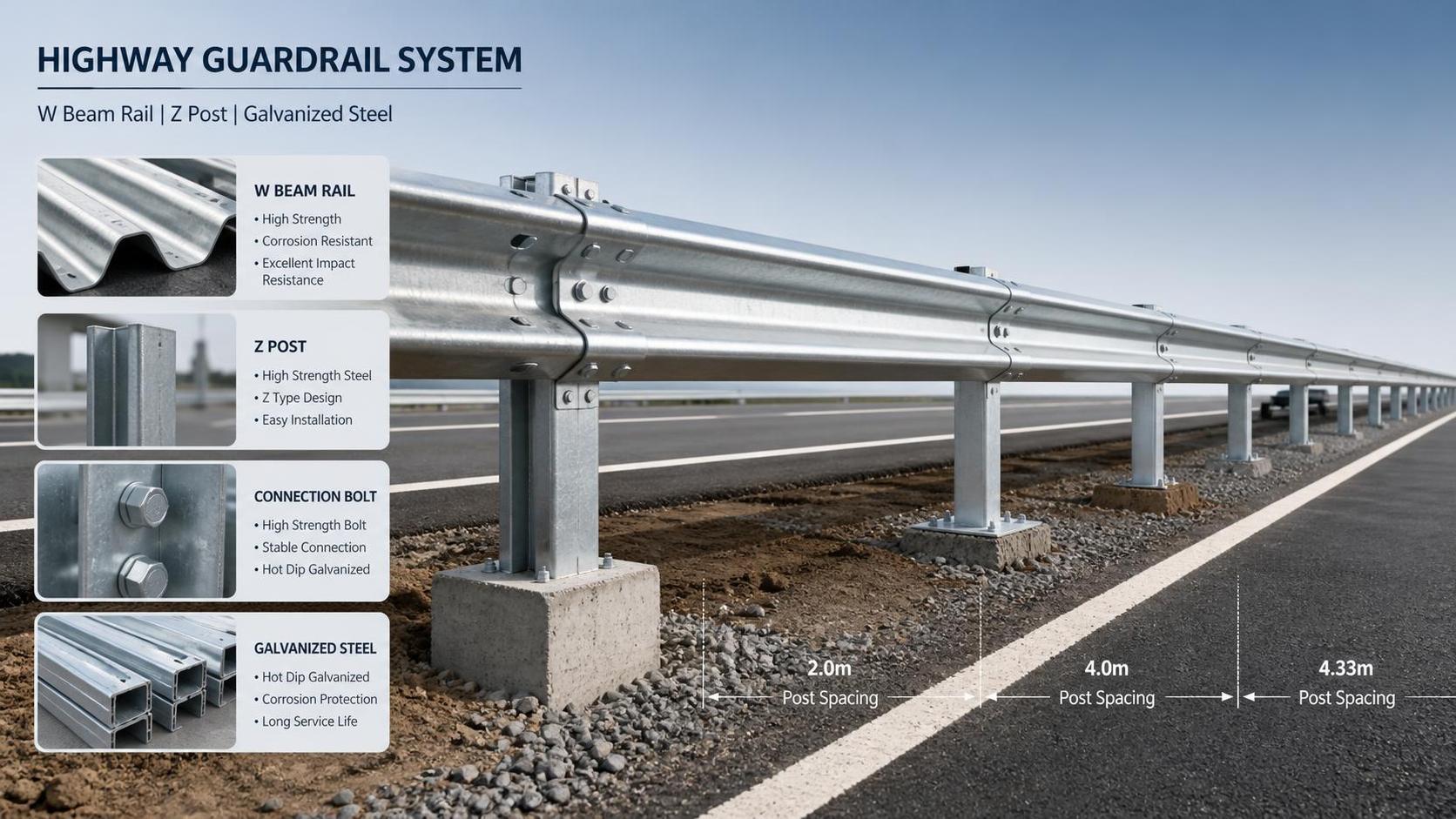
Post spacing is often read as a layout dimension. In reality, it is a stiffness setting. Closer spacing tends to create a stiffer response with reduced rail deflection, while wider spacing usually allows more movement and more energy dissipation through system flexure. Neither is universally better. The correct spacing depends on the hazard being shielded, available deflection space, soil conditions, and the expected interaction between vehicle and rail.
On a curved section, this choice becomes more sensitive. If posts are spaced too far apart on a tighter bend, the rail may not maintain the intended alignment under load, and local deformation can become concentrated between supports. If posts are placed too closely without regard to the tested or specified configuration, the barrier can become overly stiff, increasing the chance of harsher vehicle redirection or unexpected load transfer into the posts and connections.
That is why spacing should be reviewed together with radius, not after it. A curved rail with standard-looking components may still behave differently from a straight installation using the same nominal materials.
Where Standards and Product Selection Enter the Conversation
For assessors working from drawings or procurement documents, compliance starts with the underlying system standard. If the specified product is based on AASHTO M180 geometry and material requirements, the evaluation should focus on whether the curved configuration stays within what that system can realistically support in fabrication and field installation. The issue is not only material grade or coating, but whether the full assembly still reflects a coherent roadside safety system.
A practical reference point is AASHTO M180 Guardrail, widely used for highways and hazardous road sections because the wave-shaped rail is intended to absorb impact energy and guide vehicles back toward their path. When such a system is specified with hot-dip galvanized protection and recognized standards like AASHTO M180, the technical question is not whether the product is generally suitable, but whether the bend radius, support spacing, and installation detail preserve the tested design logic of that system.
Common Misreadings in Technical Assessment
Three misunderstandings appear regularly in guardrail reviews.
The first is assuming that a curved section can be evaluated only by checking the final centerline. That ignores the mechanical effect of curvature on joint behavior and post loading.
The second is treating post spacing as a site convenience. Installers may be tempted to adjust spacing around drainage structures, pavement edges, or utilities. Some adjustment may be unavoidable, but once the spacing pattern changes, the barrier response changes with it. That should be an engineering decision, not merely a construction workaround.
The third is focusing only on corrosion protection and ignoring geometry. Long service life, even beyond 20 years in suitable conditions, is valuable, but durability does not compensate for a layout that redirects poorly. A well-coated rail can still be the wrong rail arrangement.
What a Technical Review Should Actually Check
When reviewing a Bend Highway Guardrail design, the useful questions are usually these:
- Is the radius compatible with the selected guardrail system and connection details?
- Does the post spacing remain consistent through the curve, or is stiffness changing at critical points?
- Are there fixed objects, slopes, bridge transitions, or limited working-width conditions that make a more flexible layout unacceptable?
- Can the fabricator produce the required bent sections while maintaining dimensional accuracy, hole position, and coating quality?
- Do field conditions force deviations from the drawing that should be rechecked before installation proceeds?
These checks are more useful than broad statements about one radius being safe or one spacing being better. Guardrail performance is configuration-dependent.
A Practical Reading of Performance
In real projects, the best-performing curved guardrail sections usually come from coordination between design intent, manufacturing capability, and installation control. A supplier that can work from drawings, verify bending requirements, and manage fabrication steps such as non-destructive testing and galvanizing is in a better position to deliver sections that match both geometry and durability expectations. That is especially relevant when the system must align with internationally recognized specifications, including products such as AASHTO M180 Guardrail and other approved regional standards.
For technical assessors, the right conclusion is usually a disciplined one: curved radius and post spacing should be read as performance variables, not drafting details. If the bend is sharp, if spacing changes through the curve, or if site constraints force adjustment, the system deserves closer review before it is accepted. That is where guardrail evaluation becomes engineering rather than paperwork.
Leave A Reply
Need More Details?
Contact me for details on creating and managing design projects, project features, and services and prices
consult
Our company was established in 1998. It‘s a Chinese pioneer enterprise integrating production and sales, committed to providing high-quality steel products to customers at home and abroad.

First class quality service and professional after-sales team.
Get in Touch
*We respect your confidentiality and all information are protected.