






NEWS
Categories List
Recent Posts
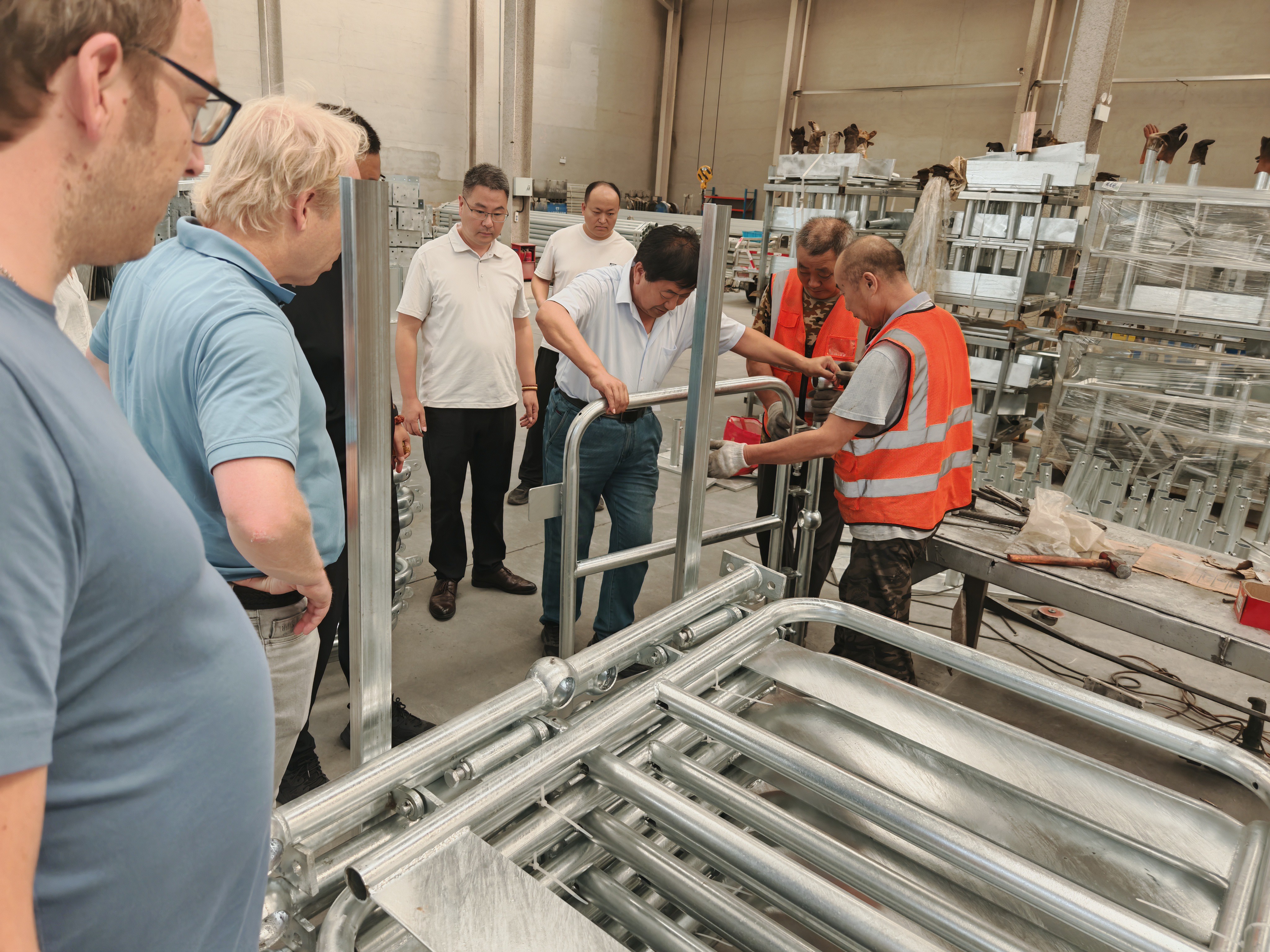
 Netherlands Client Delegation Visits Our Factory to Advance European Highway Guardrail CooperationOct 10, 2026
 Fish Plate Connectors for Rail Joints: How to Identify Wear Before It Becomes CriticalOct 10, 2026
 AASHTO M180 Guardrail Requirements: A Practical Guide to Material ComplianceOct 10, 2026
Highway Lighting starts with how the road is actually used
Highway Lighting affects more than visibility at night. It shapes driver reaction time, lane recognition, maintenance safety, and the reliability of roadside protection systems.
In transport projects, layout decisions rarely depend on brightness alone. Pole spacing, mounting height, glare control, and structural compatibility all change with road geometry and roadside risk.
That is why a good design review looks at the lighting plan together with guardrails, steel structures, drainage edges, bridge barriers, and future maintenance access.
When fabrication and installation are coordinated from drawings early, the result is usually cleaner. Hole locations, bending details, corrosion treatment, galvanizing, and coating choices can then match the lighting layout instead of fighting it later.
Different road sections create different Highway Lighting priorities
A straight expressway segment needs one kind of judgment. An interchange, bridge approach, or median opening needs another.
On long, uniform carriageways, consistency matters most. Drivers should not experience sharp changes in luminance, dark gaps, or poorly aligned poles that create a visual rhythm problem.
Near ramps and diverging lanes, Highway Lighting has to support quicker decisions. Contrast, sign readability, and recognition of barrier lines usually matter more than maximizing average illuminance.
Bridge sections introduce another layer. Wind exposure, limited shoulder width, inspection access, and steel barrier interfaces all narrow the range of practical pole locations.
Median openings and pier protection zones are also less forgiving. Here, the lighting arrangement should avoid weakening protective systems or creating new impact points close to conflict areas.
A quick comparison helps before layout is frozen
Where pole placement often succeeds or fails
Many Highway Lighting problems begin with pole placement that looked acceptable on a plan but was weak in field conditions.
A common mistake is setting poles by available space only. Shoulder width, clear zone limits, guardrail deflection, and maintenance vehicle access should be checked together.
This is especially important where lighting poles sit near barriers or bridge edges. If the support system and roadside steelwork are reviewed as one assembly, fewer conflicts appear during installation.
In severe locations, reinforced terminal and transition details may be justified. Components such as End Cover are often considered around ramp divergences, pier protection zones, and other impact-sensitive sections.
That choice is not about adding hardware everywhere. It is about using higher-stiffness steel protection where collision deformation must be limited and guidance performance must remain stable.
Energy efficiency matters, but not in the same way everywhere
On low-complexity highway sections, efficient spacing and optical control usually deliver the best value. Extra poles can raise power use and maintenance burden without improving safety.
At conflict points, reducing fixture count too aggressively can backfire. Drivers need clearer lane edge definition and earlier recognition of merges, curves, and barrier transitions.
More practical reviews compare lifecycle outcomes, not just initial quantities. Lamp access, corrosion exposure, recoating cycles, replacement traffic control, and spare part standardization all affect the real cost of Highway Lighting.
In coastal corridors or salt-fog environments, material durability should be part of the lighting decision. Protective steel components with zinc-aluminum-magnesium or powder coating systems can support longer service performance in exposed zones.
Some sections need lighting and safety hardware judged together
Highway Lighting becomes harder to evaluate where barriers, poles, and structural steel share a narrow corridor. Bridge sections are the clearest example, but not the only one.
Openings in median strips, toll approaches, and expressway transition points often require combined checks for crash behavior, sight lines, and installation tolerances.
In these areas, fabrication quality matters because dimensional errors multiply quickly. Accurate drilling, controlled bending, rust removal, shot peening, non-destructive testing, galvanizing, and painting help the built system match the approved layout.
Where drawings already define the geometry, custom production usually gives a better fit than forcing standard parts into irregular conditions. That is often the difference between a tidy lighting corridor and a compromised one.
Checks that are often skipped too early
- Whether barrier deflection under impact could reach the lighting pole base.
- Whether maintenance crews can access luminaires without blocking critical lanes.
- Whether coatings and steel grades fit local corrosion exposure.
- Whether glare control remains acceptable after final mounting height changes.
- Whether one detail is being reused across sections with very different risk levels.
Misjudgments usually come from treating similar locations as identical
Two ramps may look similar on plan view but behave differently at night. One may have heavier truck movement, tighter curvature, or more rainwater reflection.
The same applies to roadside protection. A high-rigidity detail such as End Cover may be suitable in a critical impact zone, yet unnecessary on a lower-risk segment.
Another frequent error is evaluating Highway Lighting without long-term maintenance conditions. A layout that meets target values on paper may become hard to service once barriers, drainage structures, and traffic staging are added.
Better decisions usually come from matching each section to its actual operating pattern, not to a generic highway template.
A better next step is to review layout by section, not by average values
For safer night roads, Highway Lighting should be checked section by section. Straight runs, ramps, bridge approaches, and protected hazard zones deserve different thresholds and different detailing questions.
Start with the drawing set, then compare pole placement, barrier interaction, corrosion exposure, and maintenance access against each road condition. That process usually reveals where standard layouts still work and where custom steel coordination is needed.
When those checks are done early, it becomes easier to confirm performance, fabrication scope, installation sequence, and long-term upkeep before the project moves into procurement or site work.
Leave A Reply
Need More Details?
Contact me for details on creating and managing design projects, project features, and services and prices
consult
Our company was established in 1998. It‘s a Chinese pioneer enterprise integrating production and sales, committed to providing high-quality steel products to customers at home and abroad.

First class quality service and professional after-sales team.
Get in Touch
*We respect your confidentiality and all information are protected.