






NEWS
Categories List
A low purchase price can quickly lose its value when a highway barrier shipment arrives with incomplete documentation, mismatched hole patterns, insufficient coating quality, or posts that do not suit the intended roadside condition. For a distributor, the resulting problem is not only a delayed delivery. It can affect tender eligibility, warehouse planning, installer confidence, and the ability to support downstream buyers when questions arise on site.
Before stocking a Highway Safety Barrier System, the most important check is whether the manufacturer can supply a consistent, documented system rather than a collection of individual steel parts. The rail, post, spacer block, fasteners, coating, dimensions, and installation requirements must work together. A practical buying decision starts with project fit and compliance evidence, then moves to manufacturing control, supply reliability, and technical support.
Start with the system requirement, not the rail profile alone
Guardrails may appear similar in a product catalogue, but their suitability depends on the full assembly. A distributor should first clarify what type of applications customers are likely to serve: routine roadside sections, bridges, curves, embankments, median areas, access roads, or locations with restricted foundation conditions. Each situation can change the required post arrangement, spacing, rail length, connection details, and installation method.
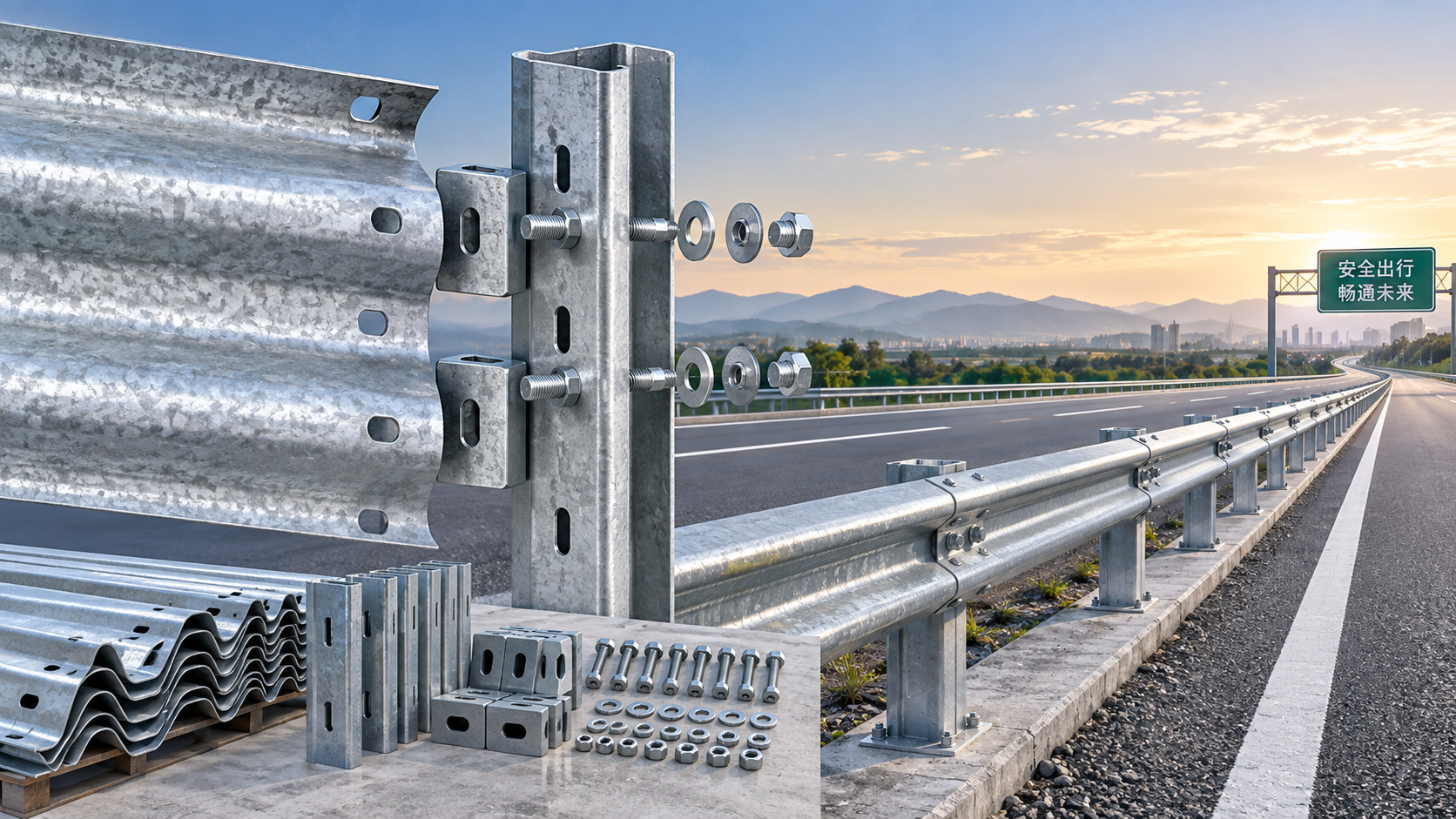
Before placing stock orders, request a clear description of the proposed barrier assembly. It should identify the rail profile, post type, block or spacer arrangement, bolt set, terminal-related components where applicable, and the expected connection method. This avoids a frequent stocking mistake: holding rails and posts that are individually usable but not dimensionally compatible with one another.
It is also useful to separate standard inventory from project-specific material. Standardized components may be appropriate for recurring demand, while non-standard lengths, hole positions, post sections, or special transitions should normally be controlled against approved drawings. Stocking a large quantity of a non-standard item without confirming its wider applicability can create slow-moving inventory that is difficult to redeploy.
Check standards and documentation before discussing volume
Compliance is often treated as a document request made at the end of a negotiation. It should be addressed earlier. Buyers downstream may need to verify material grade, dimensions, coating process, inspection records, and system configuration before approving a supply source. A manufacturer should be able to explain which international standards its products are manufactured and inspected against, and which documents can be supplied with an order.
Ask specifically what records are available for the components being quoted. Depending on the specification and purchasing process, this may include:
- material information and traceability records for steel inputs;
- dimensional inspection records for rails, posts, holes, and formed sections;
- galvanizing or coating inspection information;
- manufacturing and quality-control procedures;
- packing lists that identify component types and quantities clearly;
- drawing confirmation for customized parts.
The key question is not simply whether paperwork exists. It is whether the documents correspond to the actual material being delivered. A generic certificate that does not identify the relevant production batch, component, or order provides limited help when an installer finds a discrepancy after delivery.
Inspect steel processing and corrosion protection as separate decisions
Outdoor roadside steel is exposed to moisture, temperature changes, road debris, and site-specific environmental conditions. Corrosion resistance is therefore a supply decision, not a cosmetic preference. Hot-dip galvanizing is commonly specified for guardrail components because it protects the steel surface over long periods of outdoor service. However, a distributor should understand what is included in the supplier's process rather than assume every galvanized product has the same preparation and finish.
Ask how steel is prepared before galvanizing and whether fabrication steps such as drilling, bending, rust removal, shot peening, and inspection are controlled before the finished coating is applied. Hole edges, bends, weld areas, and cut surfaces deserve attention because these are areas where poor fabrication control can create installation or durability concerns.
When reviewing samples or pre-shipment information, look beyond color and appearance. Confirm that the coating process matches the specification, that surfaces are reasonably uniform, and that parts can still be assembled without excessive interference at bolt holes or connections. Galvanizing should protect the component without creating avoidable fit-up problems.
Painted steel may also be requested for particular project conditions or visual requirements. In that situation, clarify whether painting is applied over galvanized steel or another prepared surface, what preparation is expected, and how touch-up requirements will be handled after transport or installation. Do not assume that a painted finish eliminates the need to assess the underlying corrosion-protection method.
Posts determine whether the barrier assembly remains stable
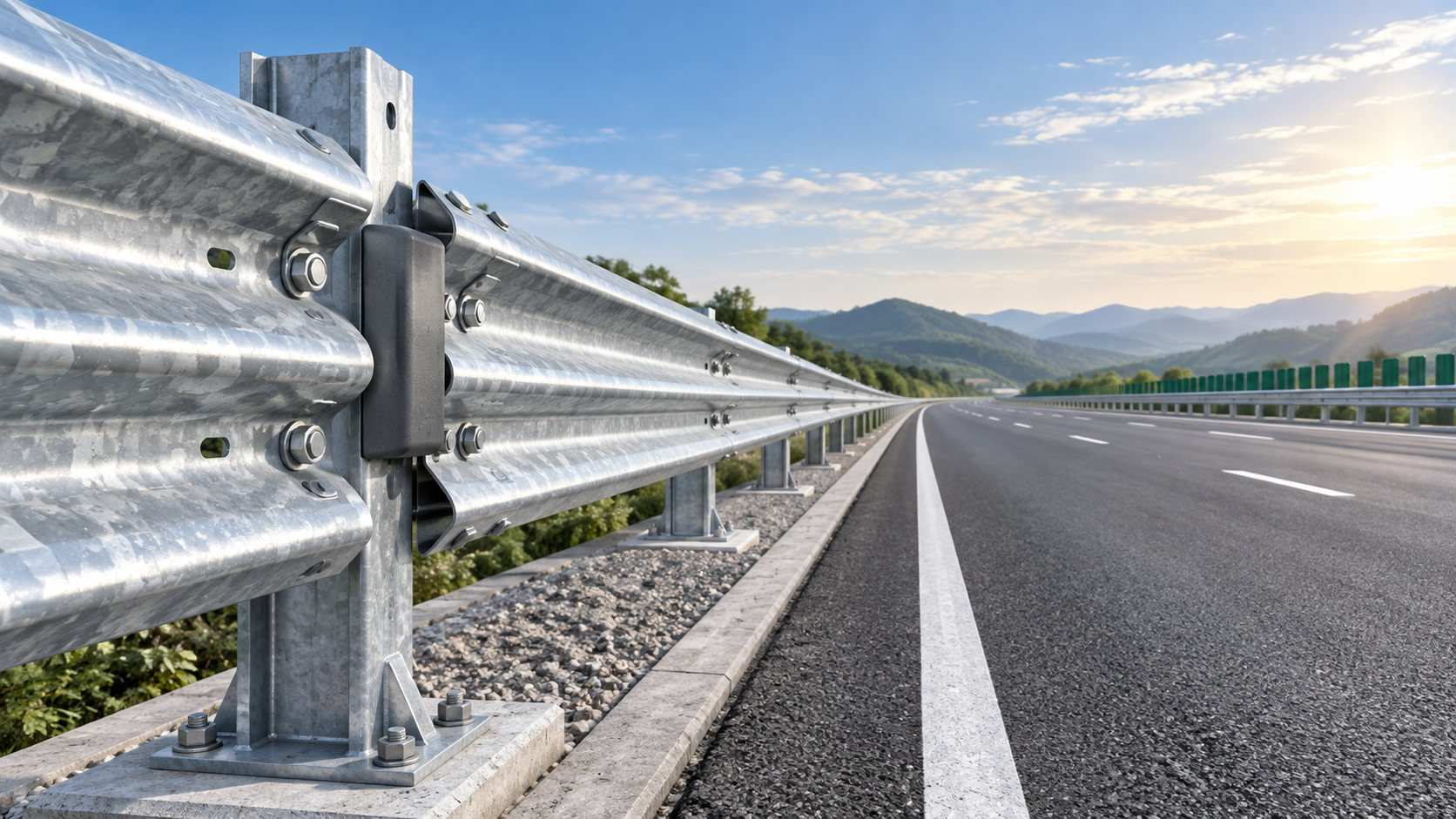
Rails receive most of the visual attention, yet posts transfer and disperse force into the foundation. Their section shape, length, thickness, spacing, and embedment arrangement affect whether the guardrail line can maintain its intended position under service conditions. A rail system cannot perform as intended if the supporting posts are unsuitable for the ground condition or incorrectly matched with the rail and spacer blocks.
For example, a common arrangement uses a standard post spacing of 4 meters, while critical locations may require spacing of 2 meters. This is not a detail to leave to warehouse staff or installation crews to interpret later. The spacing must be checked against the relevant layout, drawings, and required system configuration before material is stocked or quoted.
When sourcing posts, confirm the available section types and whether the supplier can maintain consistent dimensions across production batches. C-type, U-type, Z-type, and H-type posts may serve different system designs or site needs. Where a customer has unusual ground conditions, existing structures, or drawing-defined geometry, the supplier should be able to review the requirement rather than force a standard post into an unsuitable application.
For stock intended to support roadway projects, C Posts can be considered where their dimensions and connection arrangement match the specified guardrail assembly. These posts are used to provide vertical support and load transfer, helping disperse force into the foundation and reducing the risk of significant shifting or overturning of the barrier line. Their suitability still depends on the approved layout, soil or foundation condition, and matching accessories.
Verify connection compatibility before containers or pallets are released
Many field problems originate at the connection points. A rail may be correctly formed, and a post may meet the stated section size, but the system can still be difficult to install when bolt diameters, hole locations, spacer-block dimensions, or overlap directions are inconsistent. These issues often become visible only after crews begin assembly, when replacement material is more expensive and schedules are less flexible.
A useful pre-order review is to place the supplier's component drawings side by side and check the full connection sequence. Confirm:
- rail length, profile, and overlap direction;
- post center-to-center spacing and hole alignment;
- bolt grades, quantities, diameters, and included washers or nuts;
- spacer or energy-absorbing block dimensions;
- compatibility between rail, post, block, and connector;
- special requirements for curves, transitions, bridge sections, or reduced spacing.
It is better to ask for assembly drawings before committing to inventory than to rely on product names such as “standard guardrail bolt” or “standard post.” Names are not dimensional specifications. A reliable supplier should be able to manufacture according to approved drawings and identify any feature that could affect interchangeability with the buyer's existing stock.
Assess customization without turning every order into a special project
Distributors often need a balance between repeatable stock items and the ability to respond to drawing-based requests. The manufacturer should have a clear process for non-standard fabrication, especially for drilled holes, bent sections, altered post lengths, and unusual connector arrangements. Just as important, the supplier should distinguish between what can be produced from an existing standard and what requires a confirmed technical drawing.
Before accepting a customized order, establish who approves the final drawing, which revision controls production, what tolerances are relevant, and whether a sample or first-piece inspection is appropriate. This is particularly important for posts installed near drainage structures, retaining elements, bridge decks, or other constrained roadside features. A change that seems minor in a drawing can prevent the component from fitting the actual installation condition.
Where matching energy-absorbing blocks and bolted connectors are supplied with the posts, confirm that they are included in the bill of materials rather than assumed to be available separately. Component completeness matters when distributors are supplying installers who expect a usable assembly, not a partial package requiring last-minute sourcing.
Review supply capacity through operational questions
A manufacturer may quote an attractive lead time, but distributors should test whether that time reflects real production planning. Ask which processes are performed under the supplier's control, how galvanizing and inspection are scheduled, how custom and standard orders are separated, and what happens when drawing approval is delayed. The answers reveal more than a single delivery promise.
Packaging also deserves attention. Guardrail rails, posts, and fasteners travel differently and should be identified so that warehouse teams can receive, count, and issue components without confusion. Confirm bundle marking, component labels, weight information, fastener packaging, protection against handling damage, and whether different post types are kept distinct. Clear packing reduces errors when inventory is later broken down for smaller orders.
For recurring stock, consider ordering in a way that supports traceability by batch and component. Mixing visually similar parts from several sources can make later identification difficult, especially when dimensions or bolt patterns differ slightly.
Use a practical approval sequence
A disciplined approval process can prevent most avoidable stocking errors. First, define the system configurations likely to be sold and identify which items are truly standard. Next, compare drawings and connection details across rail, post, block, and bolt components. Then review material, coating, and inspection documentation for the quoted configuration. Only after those checks should volume, delivery schedule, and warehouse quantities drive the final purchase decision.
Before a first major order, request enough technical information to let an installer or engineering reviewer understand how the system is assembled. If the supplier cannot explain post spacing, accessory compatibility, coating process, or drawing-control procedures, the risk is not limited to that first shipment. It may indicate that future customized requests will be difficult to manage.
The strongest inventory position is built around components that are documented, compatible, traceable, and practical to install. Price remains important, but it should be compared against the cost of rejected material, missing connectors, coating disputes, incompatible stock, and delayed project approval. For a Highway Safety Barrier System, those operational risks usually matter far more than a small difference in unit cost.
Leave A Reply
Need More Details?
Contact me for details on creating and managing design projects, project features, and services and prices
consult
Our company was established in 1998. It‘s a Chinese pioneer enterprise integrating production and sales, committed to providing high-quality steel products to customers at home and abroad.

First class quality service and professional after-sales team.
Get in Touch
*We respect your confidentiality and all information are protected.