






NEWS
Categories List
Recent Posts
Steel Traffic Barriers: Comparing Galvanized Coatings for Long-Term Exposure
A Steel Traffic Barrier is expected to retain its structural function for years while facing rainwater, road salt, de-icing chemicals, airborne chlorides, ultraviolet exposure, and industrial pollution. In practice, corrosion protection is not a cosmetic decision made after the barrier design is complete. It affects inspection intervals, repair planning, replacement cost, and the reliability of components that must perform correctly during a vehicle impact.
For technical evaluation teams, the useful question is not simply whether steel is galvanized. It is which galvanizing process is specified, how consistently the coating covers fabricated details, whether the coating system suits the local corrosivity category, and how compliance will be verified before shipment and installation. A coating that performs well on a dry inland roadway may not provide the same margin on a coastal bridge approach or in a tunnel portal affected by industrial emissions.
Why galvanizing choices matter on roadside structures
Zinc protects steel through both barrier protection and sacrificial action. When a localized scratch exposes a small area of steel, nearby zinc can corrode preferentially and reduce the risk of underfilm rusting. That advantage is particularly relevant for guardrails, posts, brackets, fasteners, and beam sections subject to handling damage, debris impact, and periodic maintenance.
However, zinc is consumed over time. The rate depends on the environment, retained moisture, chloride deposition, pollutants, temperature cycles, and crevices where dirt and water accumulate. This is why an evaluator should assess the complete assembly rather than approving coating thickness from a single flat coupon. Bolt interfaces, drilled holes, folded edges, drainage locations, weld zones, and overlapping members are frequent starting points for corrosion problems.
A barrier system also has a safety dimension that ordinary structural steelwork may not. Severe corrosion at posts, connections, or rail splices can alter section capacity and connection behavior. The original crash-tested arrangement, where applicable, should not be treated as independent from durability: a corroded system may no longer behave as the configured design intended.
The main coating routes and their practical limits
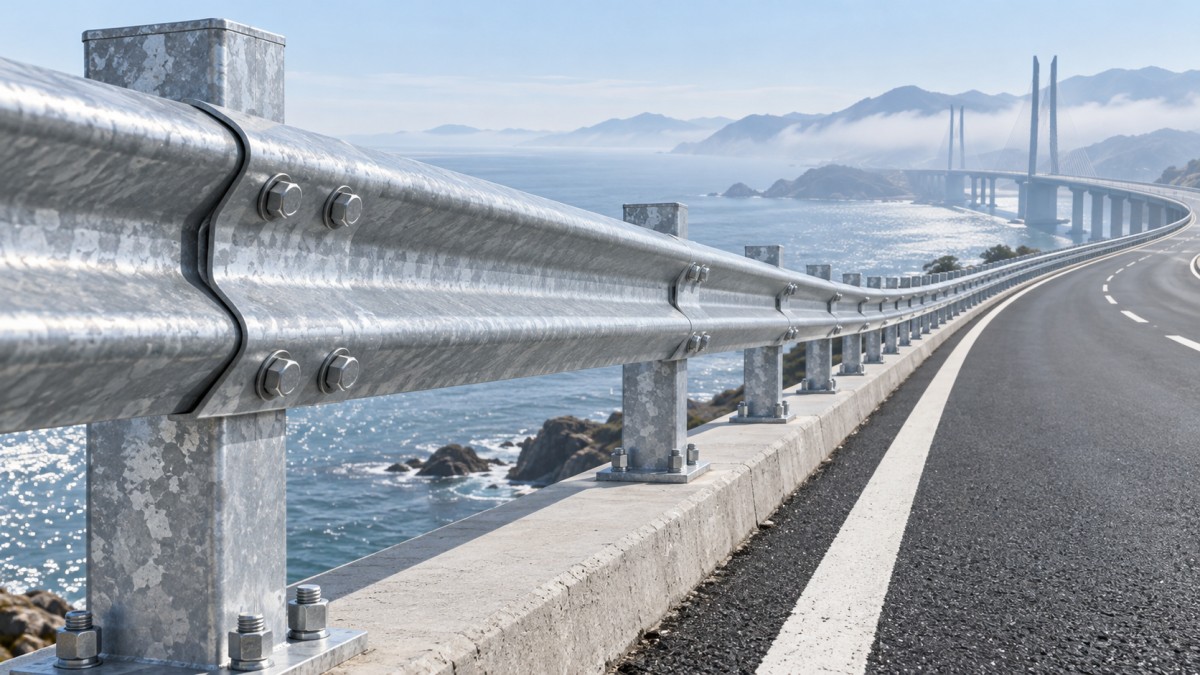
Batch hot-dip galvanizing is commonly selected for fabricated traffic-barrier components. Completed steel members are immersed in molten zinc, producing a metallurgically bonded coating that follows external surfaces and, where venting and drainage are properly designed, accessible internal areas. Standards such as ISO 1461 or ASTM A123 are often referenced for hot-dip galvanized fabricated iron and steel, but the project specification must identify the applicable edition, acceptance criteria, and any additional highway authority requirements.
The strength of batch galvanizing is robust all-around coverage on beams, posts, brackets, and complex assemblies. Its limitations are equally important: poor fabrication design can cause uncoated pockets, trapped process fluids, distortion, rough deposits, or drainage-related defects. Holes, hollow sections, weld closures, and overlapping plates should therefore be reviewed before galvanizing—not addressed during final inspection.
Continuous hot-dip galvanizing is applied to coil steel before forming. It can provide uniform, controlled zinc or zinc-alloy coatings on sheet and strip, often governed by standards such as EN 10346 where applicable. It is efficient for components produced from formed sheet, but cutting, punching, bending, and welding create areas that need careful consideration. Whether it is suitable for a given Steel Traffic Barrier depends on the component geometry, forming route, required material properties, and local standard requirements.
Electrogalvanizing can produce smooth, accurately controlled coatings, but it is generally thinner than coatings obtained through hot-dip processes. It is more familiar in enclosed or less aggressively exposed applications than on heavy fabricated highway restraint hardware. It should not be accepted as an equivalent alternative merely because both finishes are called “galvanized.” The coating mass, intended environment, component function, and relevant specification need to support the substitution.
Zinc-aluminum-magnesium coatings are increasingly considered where enhanced corrosion resistance is needed, particularly on formed steel products and cut edges. Their behavior differs from conventional pure-zinc coatings, and performance claims should be linked to the actual product standard, coating designation, fabrication method, and exposure conditions. Evaluators should not assume that a zinc-aluminum-magnesium designation automatically resolves issues caused by stagnant water, unsealed overlaps, or incompatible fasteners.
Thickness alone is not the whole specification
Coating thickness is a useful durability indicator, but it must be interpreted correctly. A thicker coating generally provides more zinc reserve, yet it cannot compensate for poor adhesion, inadequate surface preparation, poorly protected welds, or a design that traps chlorides. Thickness requirements also vary by steel thickness, galvanizing standard, and contract specification. It is safer to state the governing standard and acceptance method than to copy a nominal micron value from an unrelated project.
Before galvanizing, the steel surface needs consistent preparation. A sound production route may include rust removal, cleaning, pickling where required by the process, and controlled handling so that oils, weld residues, paint marks, and slag do not interfere with coating formation. Shot peening or blasting may be used in the wider manufacturing process, but its suitability and sequence must align with the selected coating system. For critical fabricated barrier parts, dimensional checks and non-destructive testing may also be appropriate before the coating prevents direct examination of the base metal.
Inspection points that reveal real coating risk
A practical inspection plan should go beyond visual confirmation that the surface looks silver and continuous. Thickness readings should be taken at representative locations using an appropriate calibrated gauge, with results recorded against the contract requirement. Inspectors should also look for bare spots, ash inclusions, sharp spikes, runs that affect fit-up, flaking, excessive roughness at connection faces, and blocked bolt holes or drainage holes.
Particular attention is needed at welds and cut ends. Weld chemistry, surface contamination, and fabrication sequence can influence coating appearance and uniformity. If touch-up is permitted, the method, preparation, compatible repair material, minimum repaired area requirements, and documentation should be agreed in advance. Field-applied paint over rust is not a substitute for a defined galvanizing repair procedure.
Fasteners deserve their own review. A well-coated beam connected with inadequately protected bolts, washers, or anchors can develop corrosion at the joint first. The specified fastener coating, thread fit after galvanizing, and material compatibility should be checked as an assembly. This becomes more critical in wet bridge zones, median openings, and locations exposed to repeated salt spray.
When a duplex system is justified
A duplex system combines galvanizing with a paint or powder coating. It is worth considering where the exposure is severe, where warning visibility is required, or where a project needs a defined appearance. The paint layer limits zinc consumption while the zinc layer protects steel if the topcoat is damaged. But duplex performance depends heavily on surface conditioning, coating compatibility, edge coverage, curing control, and repair procedures after installation.
For example, high-risk expressway locations may require a beam profile with high stiffness and impact resistance as well as a corrosion strategy matched to the environment. The Open Box Beam 4.8m uses a hollow rectangular cross-section made from high-quality hot-rolled steel plate and can be supplied with zinc-aluminum-magnesium or powder-coated finishes, including warning colors. Its stated long-service-life objective in coastal or high-salt-fog conditions should still be verified against the project’s actual exposure classification, installation details, and maintenance assumptions.
Specify the fabrication route before approving the finish
Corrosion protection should be built into the manufacturing package from the drawing stage. This includes confirming beam geometry, punching and drilling locations, bend radii, welding details, vent and drain provisions for hollow members, tolerances after galvanizing, and areas requiring masking or post-coating assembly. A supplier able to work from project plans or manufacturing drawings can coordinate quotation, design review, fabrication, galvanizing, painting, and installation support around those interfaces rather than treating them as separate transactions.
For a technically defensible Steel Traffic Barrier specification, define the governing barrier-performance standard separately from the corrosion-protection standard; identify the exposure environment; require traceable inspection records; and clarify whether repairs, paint systems, or alternative zinc-alloy coatings are permitted. That approach gives evaluators a clearer basis for comparing offers and reduces the chance that a lower initial coating cost becomes an early maintenance issue on the road.
Leave A Reply
Need More Details?
Contact me for details on creating and managing design projects, project features, and services and prices
consult
Our company was established in 1998. It‘s a Chinese pioneer enterprise integrating production and sales, committed to providing high-quality steel products to customers at home and abroad.

First class quality service and professional after-sales team.
Get in Touch
*We respect your confidentiality and all information are protected.