






NEWS
Categories List
Recent Posts
 Netherlands Client Delegation Visits Our Factory to Advance European Highway Guardrail CooperationOct 10, 2026
 Guardrail Post Weight: Why It Affects Handling, Freight Costs, and InstallationOct 10, 2026
 Managing Material Risks in Highway Construction Projects With Long Lead TimesOct 10, 2026
Managing Material Risks in Highway Construction Projects With Long Lead Times
Long-lead material risk is rarely caused by one dramatic failure. More often, it builds quietly: a guardrail drawing is still under review, a steel grade is not fully confirmed, galvanizing capacity is reserved too late, or a shipment is planned against an optimistic site date rather than the actual release date. By the time the issue becomes visible, paving crews may be approaching the section where roadside safety systems need to be installed.
For highway project managers, securing Highway Construction Materials is not simply a purchasing task. It is a coordination exercise across design, engineering approval, manufacturing, inspection, transport, site readiness, and installation sequencing. The materials most likely to cause disruption are often not the most expensive items. They are the components that cannot be substituted casually once the system design, crash-performance requirements, connection details, or corrosion-protection specification have been set.
Guardrails, posts, brackets, bolts, transition sections, and fabricated steel accessories fall into that category. A late delivery of one supporting component can leave an otherwise complete safety barrier system sitting unused on site.
Start with the material release date, not the planned installation date
A common planning mistake is to work backward from the date a crew is expected to install the guardrail. That date is useful, but it is not the correct starting point for procurement. The more important date is the last point at which the manufacturer can receive final, approved information without putting the required delivery window at risk.
This distinction matters because fabricated steel does not move through a single uninterrupted process. It may require raw material allocation, cutting or drilling, bending, rust removal, shot peening where specified, welding or assembly, non-destructive testing when required, hot-dip galvanizing or painting, final inspection, packing, and dispatch. Each step has dependencies. A drawing revision after drilling has begun is not a minor administrative change; it can mean rework, scrapped parts, or a new production slot.
The practical approach is to build a material release schedule alongside the construction programme. It should identify at least three dates for every critical package: the engineering freeze date, the manufacturing release date, and the required on-site date. These dates should not be treated as interchangeable.
Separate standard items from project-specific steelwork
Not all highway steel has the same risk profile. Standard beams or commonly used fasteners may be available through established supply channels, although availability should still be checked. Custom posts, irregular transition pieces, modified brackets, or components adapted to local ground conditions carry more uncertainty. They require more engineering clarification and are less likely to be replaced from stock if something changes.
The procurement plan should therefore distinguish between items that can be replenished and items that are effectively made for one project. This helps the team focus attention where it matters. Buying extra standard bolts may be sensible. Ordering surplus custom steel sections before the alignment, foundation details, and connection geometry are stable can create waste rather than protection.
For guardrail packages, the interface between the post and the rest of the system deserves particular attention. Post profile, wall thickness, hole position, length, galvanizing requirements, spacing, and connector compatibility must be checked as one set of information. It is risky to approve each item in isolation simply because the individual drawing appears correct.
Verify capacity in terms of process, not just factory output
A supplier may have the ability to fabricate steel sections but still face a bottleneck in a downstream process. Galvanizing capacity is a frequent example. So are specialized drilling patterns, non-destructive testing requirements, inspection hold points, and export packing. Asking whether a factory has “enough capacity” is too broad to be useful.
A stronger review asks more specific questions: Has the raw steel been allocated? Is the required tooling available? Which operations are performed in-house and which are subcontracted? When can galvanizing be booked? What inspection records will accompany the shipment? If there is a design change, which operations would need to be repeated?
This is especially important when a supplier is producing against customer drawings. The manufacturer should review the drawings before production release, not merely accept them. Hole layouts, bend radii, coating access, tolerances, and packaging constraints can all affect whether a component can be manufactured consistently. Early design-for-manufacture feedback is often less costly than a late corrective action.
Treat quality control as a schedule-control measure
Quality problems are schedule problems when replacement lead times are long. A dimensional issue discovered after delivery may prevent installation even if the material appears visually acceptable. The same is true for incomplete traceability, missing coating documentation, mismatched bolt sets, or damage caused by poor packing and handling.
The most effective inspection strategy follows the manufacturing sequence. Review incoming material identification before fabrication, verify critical dimensions before coating, inspect surface preparation and galvanizing or painting requirements at the appropriate stage, and confirm final packing against the installation sequence. Waiting until the goods reach site concentrates too much risk at the end of the chain.
For example, C Posts used in highway guardrail systems are not simply vertical steel members. They transfer load into the foundation and help prevent the barrier system from shifting or overturning under impact conditions. Standard post spacing may be 4 meters, while critical locations may call for 2-meter spacing depending on the approved system design and project requirements. That change affects quantities, installation time, fastener demand, and delivery sequencing. It should be visible in the material plan long before the crew reaches that road section.
Avoid buying too early without a storage and change plan
Early procurement is often presented as the obvious answer to long lead times. It can help, but only if the package is sufficiently defined and the project has somewhere suitable to store it. Galvanized components can still be damaged by poor stacking, standing water, rough unloading, or mixed storage with incompatible materials. Small connection parts are easily separated from the main sections, and unlabelled bundles create avoidable site confusion.
There is also a commercial and technical trade-off. If the final road geometry, utility conflicts, drainage details, or barrier transitions are still changing, an early order may lock the project into components that no longer fit. A better option can be to release stable, repetitive items first while holding genuinely variable sections until the relevant drawings are confirmed. This is not indecision; it is controlled exposure.
Link deliveries to workable installation fronts
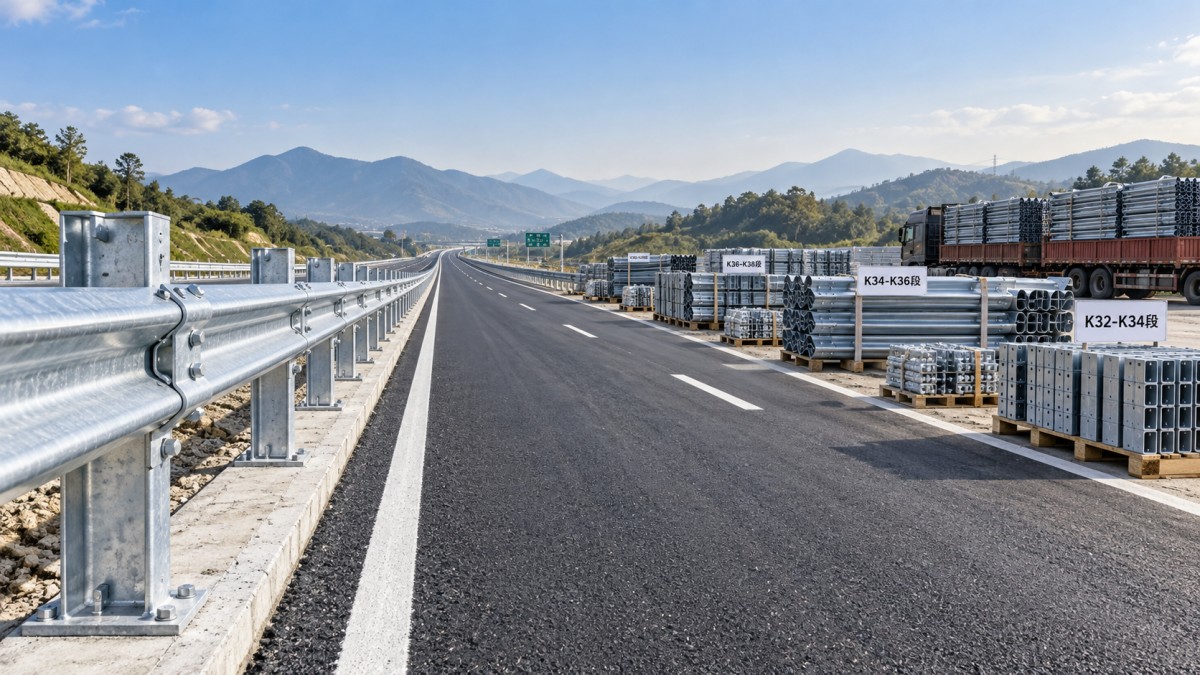
A complete delivery does not automatically mean a usable delivery. Guardrail installation depends on access, completed earthworks, approved foundation conditions, traffic management, and clear interfaces with drainage, signs, lighting, and bridge approaches. Sending all materials at once may overload a constrained site, while sending materials in arbitrary batches can leave crews short of the exact posts or connectors required for the next chainage.
Delivery planning should follow installation fronts. Pack and label materials by section where possible, and make sure the bill of materials reflects the actual installation sequence rather than only the purchasing sequence. For custom steelwork, include a final check that matching energy-absorbing blocks, bolted connectors, and post types are travelling in compatible sets. The system is only as installable as its least available component.
Keep a live risk register that triggers decisions
A material risk register is useful only when it changes behaviour. “Supplier delay” is not a workable risk description. A better entry identifies the component, the current manufacturing stage, the missing decision or dependency, the consequence for a specific construction activity, and the next owner action.
For long-lead Highway Construction Materials, weekly reviews are usually more valuable than monthly reporting. The project team should look for movement in drawing approval, raw material availability, factory slots, coating progress, inspection status, shipping documents, and site-release dates. Small variances are easier to absorb early. Once fabrication, transport, and site access problems overlap, recovery options narrow quickly.
The goal is not to eliminate every uncertainty; highway projects rarely allow that. It is to identify which decisions must be made now, which materials can be safely released, and where an apparently minor component could stop an entire installation front. That discipline is what keeps long lead times from becoming long project delays.
Leave A Reply
Need More Details?
Contact me for details on creating and managing design projects, project features, and services and prices
consult
Our company was established in 1998. It‘s a Chinese pioneer enterprise integrating production and sales, committed to providing high-quality steel products to customers at home and abroad.

First class quality service and professional after-sales team.
Get in Touch
*We respect your confidentiality and all information are protected.