






NEWS
Categories List
Recent Posts
 Netherlands Client Delegation Visits Our Factory to Advance European Highway Guardrail CooperationOct 10, 2026
 Guardrail Post Weight: Why It Affects Handling, Freight Costs, and InstallationOct 10, 2026
 Managing Material Risks in Highway Construction Projects With Long Lead TimesOct 10, 2026
For a procurement team, guardrail post weight is not a minor line item on a bill of materials. It affects what arrives on site, how many truckloads are required, what lifting equipment is needed, how quickly crews can install the system, and whether the finished barrier performs as intended under impact.
Two quotations may describe posts with similar lengths and a comparable galvanized appearance, yet differ materially in mass, section thickness, steel grade, or coating allowance. Looking only at price per post can make a lower quotation seem attractive while hiding higher freight, more difficult installation, or a product that does not match the specified crash-performance system. The useful question is not simply “Which post is heavier?” but “Is this the correct weight for the approved design, site condition, and total delivered cost?”
What determines guardrail post weight?
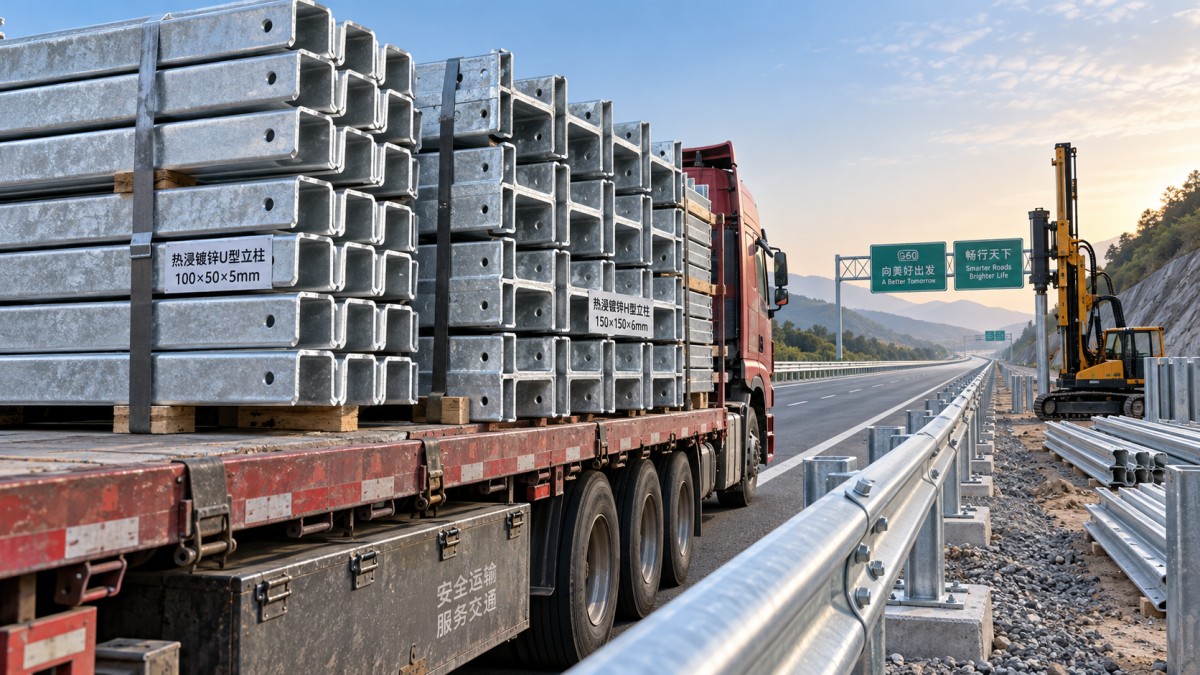
A guardrail post’s weight is primarily determined by its cross-section, length, wall thickness or plate thickness, and steel density. U-channel, C-type, Z-type, and H-type posts each distribute steel differently, so equal-length posts can have very different weights and load behavior. A taller post or a post designed for deeper embedment naturally contains more steel; a heavier section may also be required where soil is weak, roadway geometry is demanding, or impact loading is greater.
For purchasing comparison, the most practical expression is usually kilograms per meter, followed by total kilograms per piece. This makes it easier to compare posts of different lengths without confusing length with section capacity. A supplier should be able to identify the profile dimensions, nominal thickness, length, material grade, and theoretical or actual unit mass on the quotation and drawing.
Hot-dip galvanizing also adds weight. The increase is generally modest compared with the steel substrate, but it should not be ignored when freight is calculated by gross shipment weight. More importantly, galvanizing is a corrosion-protection requirement, not a substitute for adequate base steel thickness. A light post with a bright coating is still a light post.
Profile selection changes the conversation
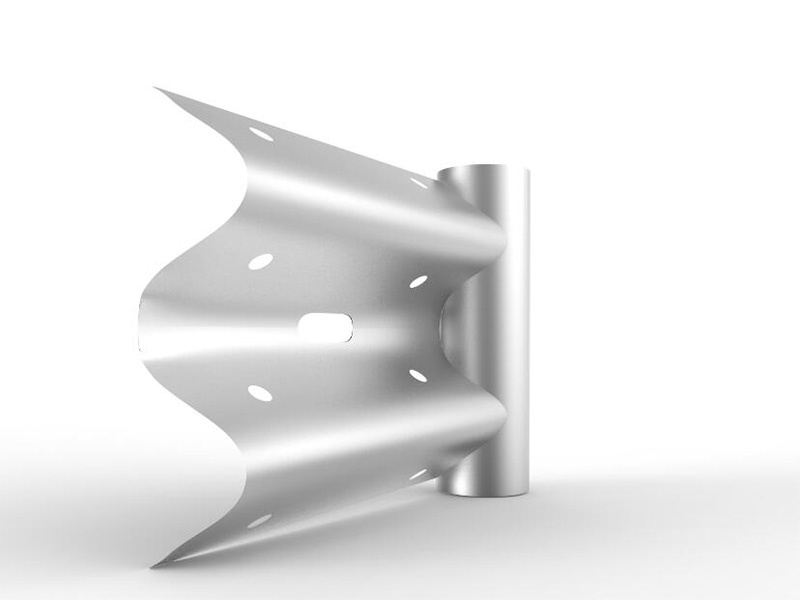
Weight alone does not prove strength. The geometry of the post influences bending resistance, stiffness, connection compatibility, and the way impact forces move from the rail into the foundation. An H-type post may be selected for a design that needs a robust structural shape, while a U-type or C-type section may suit another approved roadside system. The specified profile must be evaluated as part of the complete assembly: rail, spacer or energy-absorbing block, bolts, post spacing, soil condition, and terminal arrangement.
That is why buyers should avoid requesting “the heaviest available post” as a shortcut to safety. Over-specification can add steel cost, freight weight, drilling effort, and installation time without improving compliance. Under-specification is more serious: it can compromise system behavior and create a mismatch with the project drawings.
Why weight changes freight cost more than many buyers expect
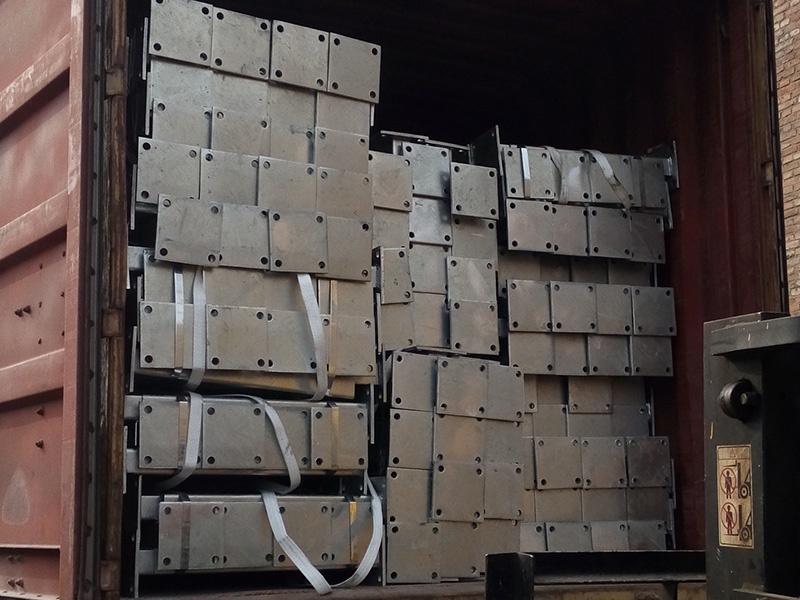
Guardrail posts are long, dense steel components. Transport planning is therefore affected by both payload limits and trailer dimensions. On a short domestic route, loading capacity may be the key cost driver. On an export shipment, bundles, container payload restrictions, port handling, and packing method can all change the landed cost.
A small increase in kilograms per post becomes significant across several kilometers of roadway. Consider a project with posts at 4-meter centers: every incremental kilogram per post is repeated hundreds or thousands of times. Critical areas may require 2-meter spacing, which doubles the post count over that section and makes accurate weight control even more important.
Freight comparisons should include more than the rate quoted per ton. Ask whether the supplier’s shipping weight includes galvanizing, base plates, caps, bolts, spacers, pallets, and export packing. A quotation based only on theoretical bare-steel weight may look lower than the final dispatch weight. Likewise, unusually low weight figures may indicate thinner material, a different profile, shorter length, or an omitted accessory rather than a genuine logistics advantage.
Installation is a weight-and-access question, not just a labor question
Heavier posts can be beneficial where the approved design requires greater section capacity, but they influence field handling. Crews may need different lifting methods, post drivers, or staging procedures. This matters on narrow shoulders, bridges, sloped verges, median work zones, and projects with limited lane-closure windows.
Installation productivity also depends on the relationship between post weight and ground conditions. A post that is difficult to drive into compacted ground may require pre-drilling or an alternative foundation detail; a post installed in loose or variable soil must still achieve the required embedment and alignment. The actual work is rarely as simple as multiplying the number of posts by a nominal installation rate.
For base-plated applications, the connection detail deserves equal attention. A U Post Base Plate arrangement can provide vertical support and transfer loads through bolted connections where driven-post installation is unsuitable. Its design should be reviewed with the anchor layout, substrate condition, post section, and guardrail system requirements in mind. The base plate is not merely an accessory; it is part of the load path.
How to compare quotations without being misled by unit price
When reviewing guardrail post weight, create a comparison sheet that puts every supplier on the same basis. Start with the project drawing and required standard, then record the offered configuration line by line. The following details are worth requesting before placing an order:
- Post type and complete section dimensions
- Length, including embedment or base-plate configuration
- Nominal wall or plate thickness and permitted tolerance
- Steel grade and material traceability requirements
- Theoretical and supplied weight per piece
- Hot-dip galvanizing specification and coating requirement
- Hole positions, slot dimensions, and compatibility with rail and spacer components
- Post spacing assumptions, especially at curves, bridges, transitions, and hazardous locations
- Bundle quantities, gross shipping weight, packing, and loading plan
This process often reveals why quotations differ. One supplier may include a longer post, thicker web, or heavier galvanizing allowance. Another may have priced a standard post while the drawing calls for a reinforced section at selected locations. Neither difference is automatically wrong, but neither should remain unexplained.
Where lighter posts create procurement risk
A lower unit mass is not automatically a cost saving. It becomes a risk when it results from changes that have not been approved: reduced thickness, altered section geometry, shorter embedment, lower-grade steel, or missing connection hardware. In highway barrier systems, components are designed to work together. Replacing one element with a lighter alternative can affect rail height, deflection behavior, bolt fit-up, and impact-force transfer.
Buyers should also be cautious when weights are rounded aggressively. A small rounding difference is normal; a large gap between quoted and calculated weight needs clarification. Request the manufacturing drawing and, where appropriate, a weight schedule by post type. For non-standard posts with different diameters, wall thicknesses, or lengths, the drawing should take priority over a generic catalog description.
Balancing structural compliance with total project cost
The best purchasing decision usually comes from evaluating cost across the project lifecycle rather than focusing on steel mass in isolation. A compliant post with suitable galvanizing may cost more to procure than a lighter alternative, yet reduce the risk of premature corrosion, site rework, rejected inspection, or replacement work. Conversely, unnecessary mass can inflate material and freight spend while slowing installation.
A capable manufacturer can help procurement teams reconcile these competing pressures by reviewing plans, producing to approved drawings, and identifying which sections are standard and which require customization. Processes such as drilling, bending, rust removal, shot peening, non-destructive testing, galvanizing, and painting should be matched to the stated project requirements—not added as vague selling points or omitted from the scope.
At critical locations, closer post spacing and matched energy-absorbing blocks or bolted connectors may matter more than simply increasing the weight of every post. Post caps also deserve attention, as they help limit rainwater entry and internal corrosion over time. These details are easy to overlook during a price comparison, but they shape the reliability of the installed system.
A practical buying conclusion
Guardrail post weight is a useful procurement indicator because it connects design, material consumption, transport planning, and installation reality. It should never be treated as a stand-alone quality score. Compare weight against the approved profile, steel grade, dimensions, galvanizing treatment, spacing plan, and connection details.
Before issuing a purchase order, ask the supplier to confirm the weight per post, total shipment weight, manufacturing tolerances, and conformity with the project drawing. That level of clarity protects the budget while helping ensure that the guardrail system delivered to site is the system the roadway was designed to use.
Leave A Reply
Need More Details?
Contact me for details on creating and managing design projects, project features, and services and prices
consult
Our company was established in 1998. It‘s a Chinese pioneer enterprise integrating production and sales, committed to providing high-quality steel products to customers at home and abroad.

First class quality service and professional after-sales team.
Get in Touch
*We respect your confidentiality and all information are protected.